
From DNS steering to full delivery orchestration — IO River, mlytics, NetScaler ITM, NS1 Pulsar, content steering in the players, and building it yourself.
Winner depends on your workload.
Winner depends on: how much you want abstracted. DNS-layer steering (NS1 Pulsar, Route 53, NetScaler ITM) moves traffic and stops there; full orchestrators (IO River's virtual edge, mlytics) add unified config, observability and switching logic at the price of a new dependency in the request path or control plane; broadcasters increasingly get switching from the format itself via HLS/DASH content steering; and DIY remains honest for estates with the engineering to own it.
A market in three altitudes
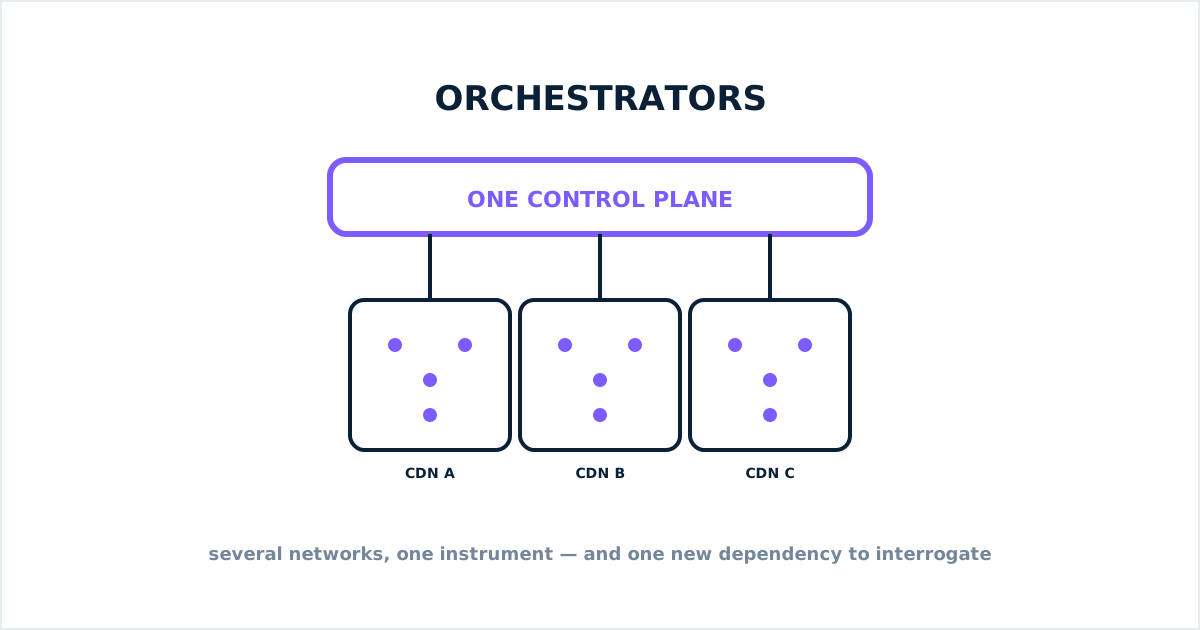
"Multi-CDN management" spans three genuinely different products. At the bottom, steering: a DNS or client-side layer deciding which CDN answers, leaving each CDN's config, logs and purge as your problem — the machinery we compared in the managed DNS roundup. In the middle, observability-plus-steering: RUM-fed platforms that measure every member and move traffic on the evidence. At the top, orchestration proper: a unified control plane that abstracts the member CDNs — one configuration model translated to each vendor, one log stream, one purge call — so the estate operates as a single virtual network.
| Player | Altitude | Notes |
|---|---|---|
| IO River | Full orchestration — a "virtual edge" unifying config, steering, observability and edge logic across members (Akamai, Cloudflare, Fastly et al.) | Founded by Akamai veterans; $20M Series A in January 2026; ~50 customers in its first selling year, media and gaming forward |
| mlytics | Steering + unified dashboard, with security features bundled | RUM-driven switching behind a single integration layer |
| NetScaler ITM | Measurement + steering — the Cedexis Radar lineage under Cloud Software Group | The community-RUM pioneer; DNS-level routing, not delivery orchestration |
| IBM NS1 Connect (Pulsar) | DNS steering with RUM feeds and commit-aware filters | Steering excellence that deliberately stops at the DNS answer |
| Format-native content steering | Switching inside the stream — HLS's second edition standardizes a steering manifest assigning pathways per CDN; DASH's equivalent is specified alongside | For video, the player itself becomes the orchestrator, mid-stream and per-session |
| DIY | Your DNS + your config pipeline + your log lake | The incumbent competitor to every product above |
What full orchestration actually buys
The honest pitch for the top altitude is operational, not architectural: everything a mixed estate makes painful — config parity, purge fan-out, log unification, cert distribution, the drift we scored in the friendliness index — becomes the orchestrator's job. IO River's framing goes further: by abstracting the members, delivery becomes a swappable commodity underneath a stable layer, which is also a procurement weapon — adding or dropping a member CDN stops being a rewrite. The structural price is symmetrical: you have added a vendor whose failure modes now sit above all your CDNs, so the orchestrator's own architecture (in the request path or control-plane only? what happens when it is down?) is the first diligence question, not the last.
The video exception
Broadcasters increasingly get switching without any of these vendors: content steering baked into the streaming formats lets a steering server reassign a session's pathway between CDNs mid-stream, per viewer, on QoE evidence — finer-grained than DNS can ever be, because it dodges resolver caching entirely. For pure video estates this is quietly eating the steering layer from inside the player; the orchestrators' answer is to become the steering server and add the config/observability layers steering alone lacks.
Buy, build, or wait
The decision tree we use: two CDNs and simple static config — DIY with good DNS steering is honest and cheap. Complex config across three-plus members, or a small team drowning in parity work — the orchestrators earn their fee, evaluated on config-translation fidelity (ask exactly which member features survive the abstraction) and exit terms. Video at scale — pilot format-native steering before buying anything. And in every case, the estate design itself comes first, which is where the multi-CDN guide starts. Facts verified against provider documentation, July 2026.
Two CDNs and rising parity pain — or weighing an orchestrator against better DIY? The assessment prices both honestly.