
Ask a vendor what a CDN costs and you get a rate card. Ask a buyer and you get a sigh. The honest answer sits in between: CDN pricing is a curve, not a number, and where you sit on it depends on volume, workload and how the deal was bought.
The curve, not the card
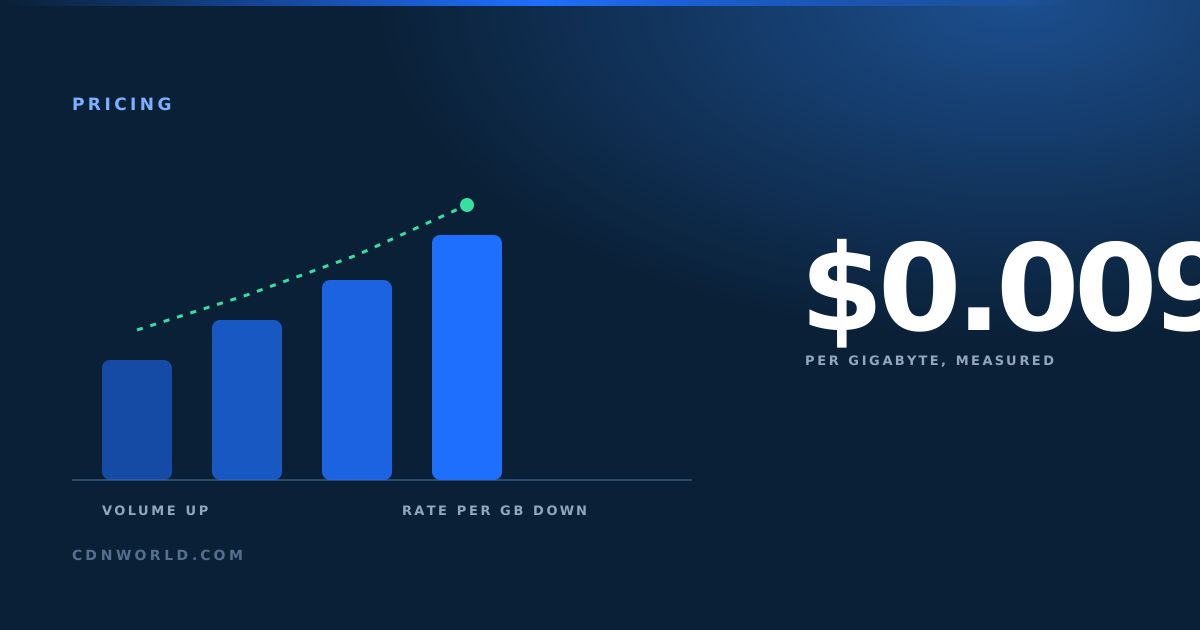
Published list rates in the market cluster around $0.06 to $0.08 per GB for entry volumes. Almost nobody pays them. Committed-volume tiers move the real rate quickly: at 100 TB a month, well-bought contracts land near $0.03 to $0.04 per GB; at 500 TB, under $0.02; at a petabyte, single digits of cents per hundred GB. Our own published tiers run from $0.035 down to $0.009 per GB, and those are channel rates on the same networks the list price buys. The spread between those points is not noise; it is the negotiating room, and knowing the shape of the curve before the first call is worth more than any single discount conversation afterwards.
What moves the number
Three things dominate: monthly volume, workload shape and region. Static content on well-cached sites is the cheapest traffic there is. Dynamic and API traffic costs more to carry. Region matters most at the edges: North America and Europe are commodity, Latin America and Oceania carry premiums, and mainland China is a separate conversation with its own filing requirements. If a quote does not ask about all three, it is a placeholder, not a price. Workload shape deserves more attention than it gets. A software-download business and an API platform can ship identical gigabytes and deserve completely different quotes, because one caches almost perfectly and the other barely caches at all. Providers know this; buyers who show they know it too get quoted differently.
A worked example makes the curve concrete. A business shipping 200 TB a month at a legacy $0.045 per GB pays $9,000 monthly. The same traffic at the 200 TB channel tier of $0.0275 costs $5,500, and if growth is credible, a 300 TB commitment at $0.025 prices at $7,500 with headroom to spare. None of these numbers required negotiation genius, only knowing the curve existed. The difference, north of $40,000 a year on a modest profile, is what buyers routinely leave on the table by treating the first quote as the market. Multiply by the size of your actual traffic and the afternoon spent benchmarking stops looking optional.
Why the same network sells at different prices
Channel economics. Resellers aggregate volume across many clients and reach tiers a single buyer rarely can, and providers price the channel favorably because it carries their sales cost. That is why buying through an aggregator is frequently cheaper than buying direct, on the identical network, portal and support. It is not a discount trick; it is how the industry actually clears. The uncomfortable corollary is that a direct relationship is not automatically the premium option it feels like. You are paying for their cost of selling to you, and that cost is real whether or not anyone itemizes it.
In practice
Take your last invoice, divide the total by the gigabytes shipped, and write that number down: it is your effective rate, and it is the only number that matters when reading this article. If it sits above the curve for your volume, the gap is your opening position. If it sits below, congratulations, and check the contract terms instead, because good rates are sometimes paid for in clauses.
Want the number for your traffic instead of the market average? The free assessment models your volumes against current rates across 25+ providers.