
Instant purge and real-time control against broadcast-scale capacity — the media-delivery version of a classic rivalry.
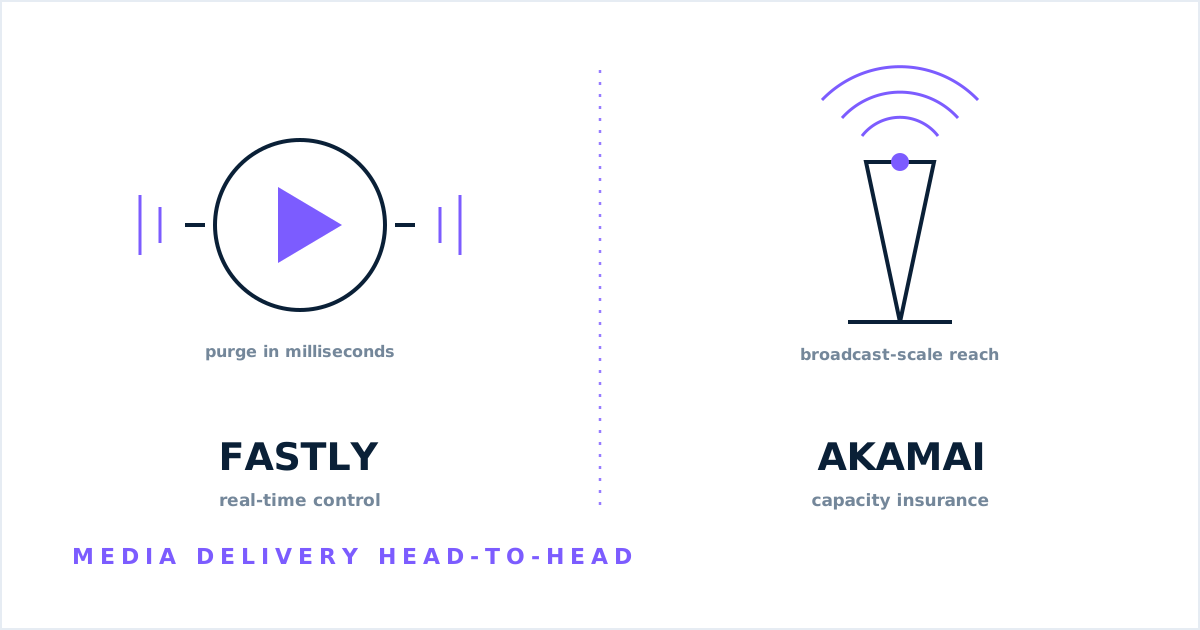
Winner depends on your workload.
Winner depends on: peak concurrency and where it lands geographically, how much your workflow depends on second-by-second config and purge control, and whether one network can be allowed to be a single point of failure on event night.
Side by side
| Fastly | Akamai | |
|---|---|---|
| Media posture | High-throughput PoPs, real-time control plane | Decades of broadcast heritage, deepest global capacity |
| Purge | Mean purge times around 150 ms — built for live workflows | Fast, but propagation historically slower than Fastly’s |
| Config changes | Deploy in seconds (VCL / Compute) | Property activations propagate in minutes |
| Footprint | Fewer, larger PoPs; strongest NA/EU | Massive PoP count, strongest hard-region reach |
| Edge logic | Compute (WebAssembly), per-request isolation | EdgeWorkers + mature delivery products |
| Typical media buyer | Streaming platforms with engineering-led ops | Broadcasters, sports rights holders, game publishers |
What “media” actually stresses
Media delivery punishes two things: capacity planning and control latency. A live final can triple your concurrency inside ten minutes, which stresses how much headroom a network really has in the regions where your audience lives. And a bad manifest, a mis-tokenized segment or a rights change mid-event stresses how fast you can change configuration and purge content globally. Akamai’s case rests on the first; Fastly’s on the second.
Fastly’s case: the real-time control plane
Fastly’s architecture bets on fewer, bigger, hotter PoPs with very high per-PoP throughput, and a control plane where configuration deploys in seconds and purges propagate with a mean around 150 milliseconds. For live sports and news workflows that is not a vanity metric: instant purge is what makes serve-then-correct workflows safe, and second-level config deployment is what lets an engineering team change token rules or failover behavior during an event instead of after it. Segment-level caching for HLS and DASH, request collapsing on hot segments, and Compute’s per-request WebAssembly isolation for manifest manipulation round out a stack that engineering-led streaming teams genuinely like operating.
Akamai’s case: the capacity floor
Akamai has carried the biggest nights in streaming for two decades, and the muscle shows in the places that only matter at scale: in-market capacity across Asia, Latin America, the Middle East and Africa; operational playbooks for events measured in tens of millions of concurrents; and delivery products tuned for broadcast — from midgress optimization to media-specific reporting. When the question is “can the network absorb our worst-case peak in every market we sell rights to,” Akamai remains the safest single answer in the industry, which is precisely why it anchors so many multi-CDN rosters, as we set out in the general Akamai vs Fastly comparison.
The economics, with workings
Two operational details deserve a line each. Tokenized delivery — signed URLs or cookies protecting segments — behaves differently on the two networks: Fastly validates tokens in VCL or Compute with logic you own and can change mid-event, while Akamai’s token auth is a mature delivery feature wired into its media products and rights workflows. And observability diverges the same way: Fastly streams real-time logs per request to your own sinks by default, where Akamai’s reporting is deeper but batch-oriented — a difference that decides which network your on-call engineers can actually debug at minute three of an incident.
Both networks price media at commit, so list rates mean little — but the shape differs. Fastly’s published posture is usage-based (bandwidth from roughly $0.12/GB at the low end, before commit discounts) with per-request fees that matter for small-object API traffic and barely at all for video segments, where objects are large and the byte-to-request ratio is favorable. Akamai’s media rates at broadcast volumes are negotiated aggressively low per GB — the leverage is volume and term. Worked example: a 500 TB/month VOD library with EU-heavy audiences will typically see both vendors quote inside the same band once negotiated; the divergence appears on live spikes, where Akamai prices capacity insurance and Fastly prices throughput you must model yourself. Figures checked against provider documentation, July 2026.
How to decide
For most serious media operations this is not either/or. The pattern we see hold up: Fastly as the primary for its control plane and observability, Akamai as the capacity anchor for peak events and hard regions — with a steering layer moving traffic between them, a design we cover in our Fastly vs CloudFront technical piece from the tooling side. If you must pick one: choose Fastly when your team ships config changes weekly and your audience is NA/EU-centric; choose Akamai when your rights map is global and event night is existential.
Planning a rights launch or renegotiating a media commit? The assessment models both networks against your concurrency curve.