
Akamai and Fastly are the comparison people reach for when the real question is culture: procurement-led scale versus engineering-led speed.
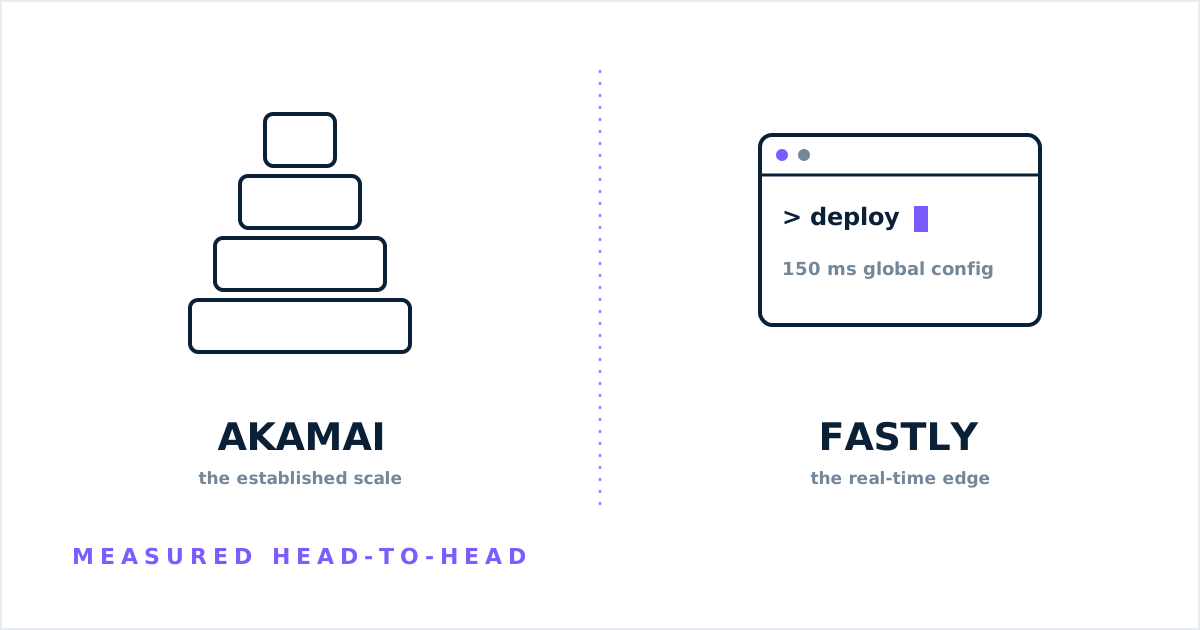
Side by side
Positioning. Akamai: The largest and longest-established edge platform. Fastly: The developer-centric real-time edge platform.
Pricing posture. Akamai: Premium; strongest at high committed volumes. Fastly: Transparent usage-based; strong value for dynamic traffic.
Best for. Akamai: Global enterprises, media at scale, security-critical workloads. Fastly: Engineering-led teams, dynamic sites, APIs, frequent deployers.
Where Akamai is strong
- The biggest global footprint in the industry, with unmatched reach in hard-to-serve regions
- Enterprise-grade security portfolio: DDoS, WAF, bot management and zero-trust products
- Deep media delivery heritage, broadcasters and games platforms at extreme scale
- Mature enterprise support, professional services and compliance coverage
Worth considering: Premium list pricing, the rate depends heavily on how well you negotiate. Configuration changes have historically been slower to propagate than newer platforms. Product breadth can mean complexity: you may be quoted more platform than you need.
Where Fastly is strong
- Instant configuration deployment and cache purging, changes take effect in seconds
- Excellent for dynamic content, APIs and event-driven traffic
- Programmable edge (VCL and compute) that engineering teams genuinely like
- Transparent, usage-based pricing that's easy to model
Worth considering: A smaller POP footprint than the giants, superb POPs, fewer of them. Regions outside North America and Europe can trail the largest networks. Request-based fees add a second billing dimension to watch.
The pricing reality
Akamai prices like the incumbent it is: list rates are a starting position, and the delivered rate depends almost entirely on committed volume and negotiating leverage — which is precisely why pooled or advisory buying moves the number more here than on any other network. Fastly publishes usage-based pricing that is easy to model, but carries a second dimension — per-request fees — that matters enormously for API-heavy and small-object traffic and barely at all for large media. Model both on your object-size histogram before comparing headline per-GB numbers.
How to decide
Run the two-question test. First: who changes your edge configuration, and how often? If the answer is engineers, several times a week, Fastly’s instant deployment is worth real money in shipped work. Second: where is your hardest traffic? If meaningful volume sits in hard-to-serve regions or you carry broadcast-scale events, Akamai’s footprint is the safer floor. Teams that answer “engineers” and “North America and Europe” usually land on Fastly; teams that answer “operations” and “everywhere” usually land on Akamai — and both should make the loser price the winner.
The honest verdict
In our benchmarks the “faster” network is different in Frankfurt than in Jakarta, and the “cheaper” one flips with your traffic mix and negotiating position. Generic comparisons, including this one, can only take you to the shortlist. The decision needs your numbers: your regions, your volumes, your contract.
Choose Akamai if: Global enterprises, media at scale, security-critical workloads describes you, and you can negotiate (or borrow leverage) on rate. Choose Fastly if: Engineering-led teams, dynamic sites, APIs, frequent deployers sounds like your team and traffic profile.