
Every route into mainland China compared — domestic giants, licensed partnerships, APAC specialists and the near-China fallback — after Akamai's exit reshuffled the deck.
Winner depends on your workload.
Winner depends on: whether you hold an ICP filing. With one, the choice is a domestic giant (Alibaba, Tencent, Huawei, Baidu), a licensed specialist (Wangsu, BaishanCloud, CDNetworks) or a Western console fronting Chinese infrastructure (Cloudflare via JD Cloud). Without one, your only honest options are getting the filing or serving from just outside the border.
The rule that decides everything else
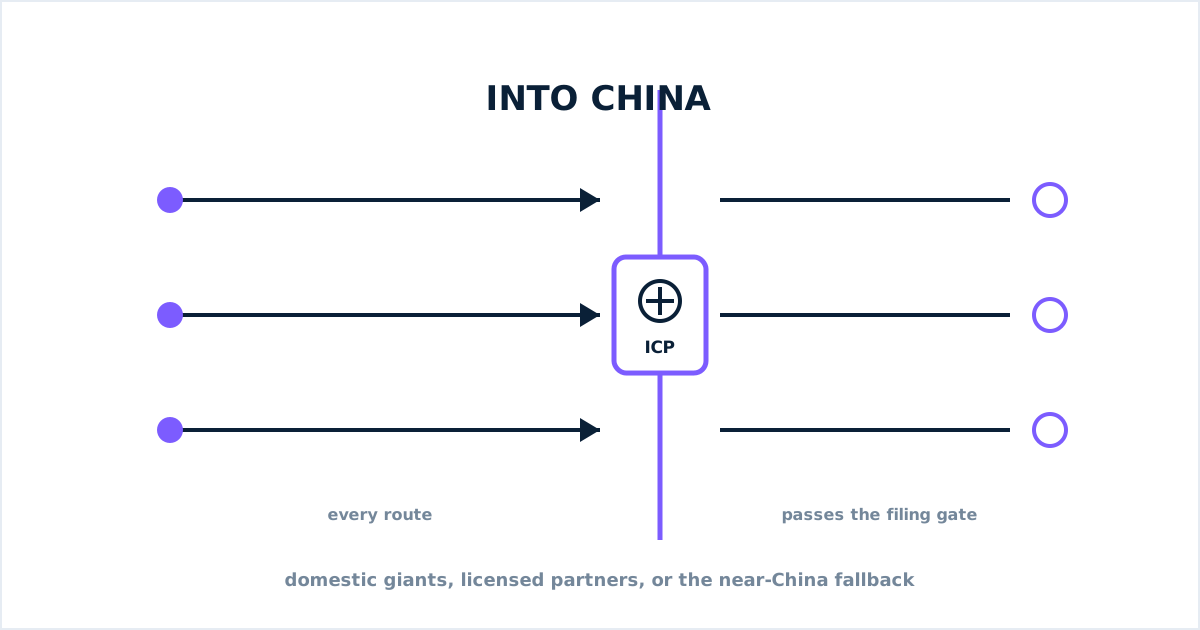
Mainland delivery starts with paperwork, not POPs: an ICP (Internet Content Provider) filing or license from Chinese authorities is required for each apex domain served from servers inside the country, and no CDN — foreign-branded or domestic — can waive it. Cloudflare's documentation is blunt about the mechanics: neither it nor its partner handles the application, and if a filing is revoked the China service can be suspended without liability, with traffic rerouted to the nearest data centers outside the mainland. Every option below assumes you either hold the filing or are choosing the one route that avoids it.
| Route | Who | What you get |
|---|---|---|
| Domestic hyperscalers | Alibaba Cloud, Tencent Cloud, Huawei Cloud, Baidu AI Cloud | The deepest mainland POP maps and lowest domestic pricing; consoles and support built primarily for the home market |
| Licensed specialists | Wangsu (ChinaNetCenter), BaishanCloud, CDNetworks, EdgeNext | Carrier-grade mainland coverage with more international-facing account handling; CDNetworks pairs it with a global network |
| Western console, Chinese metal | Cloudflare China Network (operated by JD Cloud) | Same dashboard and config as the global network, served from 30+ mainland cities; ICP per apex domain still mandatory |
| Exited direct | Akamai | Ceased direct mainland CDN on 30 June 2026, transitioning customers to Tencent Cloud and Wangsu arrangements |
| Near-China fallback | Any global CDN's HK / Taipei / Seoul / Tokyo edges | No ICP needed; latency and cross-border congestion accepted as the cost |
What Akamai's exit actually changed
The biggest structural shift of the year: Akamai ended direct mainland China delivery at the end of June 2026, moving affected customers toward Tencent Cloud and Wangsu — the pattern we unpacked when it was announced in Alibaba Cloud CDN vs Akamai China. The practical lesson generalizes: foreign CDN brands operate in China through licensed local partners, and the durability of your delivery is the durability of that partnership. Buyers should ask any vendor two questions — who holds the license your traffic rides on, and what is the contractual story if that relationship ends.
Choosing among the domestic giants
If your organization can operate a Chinese cloud account (billing entity, real-name verification, Mandarin-first support at the lower tiers), the hyperscalers are the value play, and the differences between them are mapped in our Alibaba vs Tencent rematch. The general shape: Alibaba has the broadest enterprise footprint, Tencent the strongest media and gaming pedigree, Huawei the carrier relationships, Baidu the AI-adjacent stack. All price domestic traffic at rates the global majors cannot approach; all involve a genuinely separate operational world — separate console, separate purge API, separate logs — that your multi-CDN tooling must absorb.
The one-dashboard compromise
Cloudflare's China Network is the notable exception to the separate-world problem: JD Cloud operates the mainland data centers, but configuration, WAF policy and the dashboard are the same as your global zones, and mainland users route to local POPs automatically while everyone else hits the global network. The partnership has deepened rather than wobbled — the two companies expanded it again at the end of 2025 around AI inference traffic. The trade: it is an Enterprise-tier product, the ICP obligation is entirely yours, and coverage (30+ cities) is a subset of what Wangsu or Alibaba operate. For Western teams whose constraint is operational simplicity rather than the last millisecond in Chengdu, it is often the honest pick.
When serving from outside is the right call
Plenty of estates should not chase an ICP at all: content unlikely to survive filing review, traffic too small to justify the compliance overhead, or timelines shorter than the application process. The fallback is unglamorous but real — serve China from Hong Kong, Taipei, Seoul and Tokyo edges and accept that cross-border transit is congested and variable, with performance that degrades worst at peak hours. Measure it with real user monitoring from mainland vantage points before deciding it is unacceptable; for read-heavy, non-latency-critical content it frequently is not. Facts verified against provider documentation, July 2026.
Weighing an ICP filing against near-China delivery — or picking a licensed partner after the Akamai exit? The assessment runs your numbers on real mainland RUM data.