
The rematch, drawn in geography: both giants now claim 3,200+ nodes — what the maps, meters and mainland rules actually say in 2026.
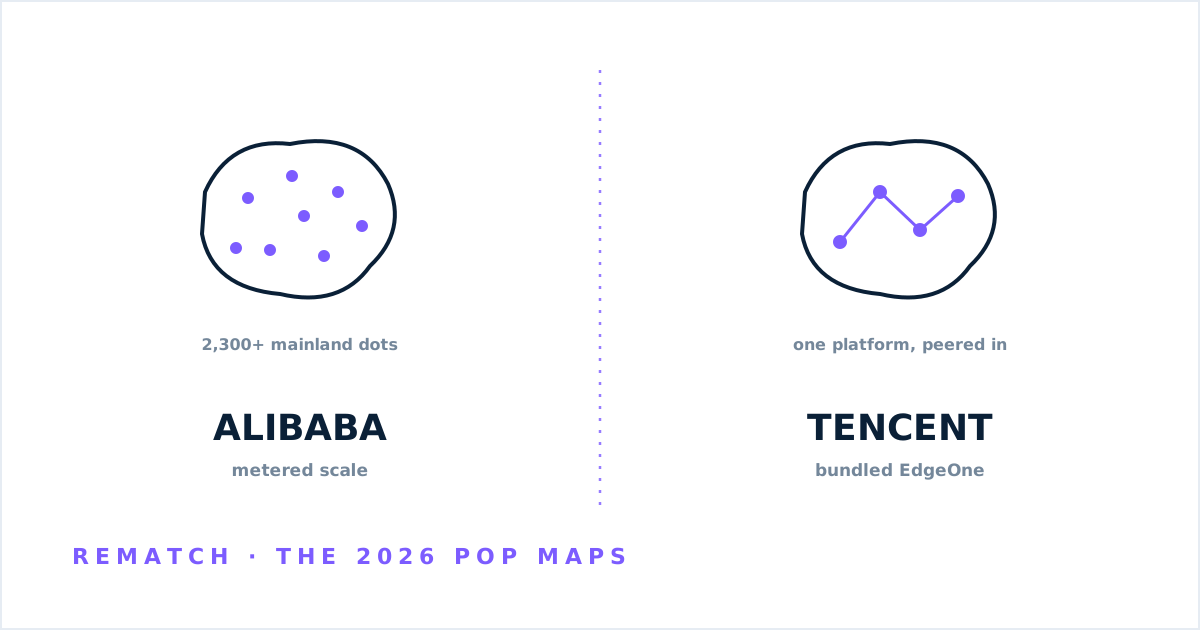
Winner depends on your workload.
Winner depends on: which side of the mainland border your audience sits, whether you prefer Alibaba’s metered model or Tencent’s subscription-plus-overage bundle, and which ecosystem your China entity already lives in.
Side by side
| Alibaba Cloud CDN | Tencent EdgeOne | |
|---|---|---|
| Claimed nodes 2026 | 3,200+ PoPs: 2,300+ mainland (all 31 provincial regions) + 900+ overseas in 70+ countries | 3,200+ edge nodes globally; mainland access activated separately |
| Capacity | 180 Tbps reserved bandwidth | Bundled with Tencent’s network; capacity not published the same way |
| Model | Metered: pay-by-traffic (from ~$0.04/GB mainland) or daily peak bandwidth | Plans: Free / Personal / Basic / Standard / Enterprise + overage |
| Security posture | CDN, DCDN lineage now consolidated as Edge Security Acceleration (ESA) | CDN + DDoS + WAF + bot fused in one EdgeOne product |
| Free entry | Trial/resource plans | Free plan including mainland China access with ISP peering |
| Mainland prerequisite | ICP filing | ICP filing |
Why redraw the maps
When we last compared these two in Tencent vs Alibaba CDN, the contest read as Alibaba’s scale against Tencent’s consumer-network pedigree. Two things changed enough to justify a rematch. Both vendors’ published node counts converged — each now claims roughly 3,200 points of presence — and Tencent reorganized its offer around EdgeOne, a fused delivery-plus-security platform whose free tier includes something no other CDN gives away: mainland China access. The map question in 2026 is no longer who has more dots, but where the dots are and what it costs to light them up.
Reading the two maps honestly
Alibaba publishes the more detailed geography: over 2,300 mainland PoPs covering all 31 provincial-level regions, plus 900-plus PoPs across 70-plus countries outside, riding 180 Tbps of reserved bandwidth, with overseas nodes individually sized at 40 TB–1.5 PB of storage and 40–200 Gbps each. Tencent’s EdgeOne claims a matching global total with an architecture note that matters operationally: mainland acceleration is a separately activated domain of the platform, reflecting the regulatory wall every provider must respect. In practice both networks blanket the mainland at provincial depth and cover the usual global map; neither should be chosen on node count — at these densities, per-city benchmarks on your own traffic decide, not brochure totals.
The meters versus the bundle
The billing models have diverged more than the maps. Alibaba stays classically metered: pay-by-traffic from roughly $0.04/GB at the mainland entry tier (stepping to $0.03 past 50 TB), or pay-by-peak-bandwidth for flatter traffic, billed daily with mainland and overseas metered separately. Tencent sells EdgeOne as plans — Free, Personal, Basic, Standard, Enterprise — with overage, bundling DDoS mitigation, WAF and bot controls into the subscription whether or not you switch them on. Worked example at 30 TB/month mainland: Alibaba meters to roughly $1,200; EdgeOne’s equivalent lands as a plan fee plus overage that typically prices comparably — but includes the security stack a metered Alibaba estate would compose from separate products. Figures checked against both providers’ published pricing, July 2026.
The strategic subtext
One 2026 development tilts perception: when Akamai wound down its direct mainland CDN this June, it named Tencent Cloud — alongside Wangsu — as a transition partner, a considerable endorsement of EdgeOne’s enterprise readiness that we unpack in Alibaba Cloud CDN vs Akamai China. Alibaba’s counterweight is ecosystem gravity of its own: the deepest cloud market share in China, OSS-origin integration, and the ESA consolidation folding dynamic acceleration and security into one edge product. Both remain subject to the same non-negotiable: an ICP filing tied to a China-registered entity before a single mainland byte is served.
How to decide
Follow your China entity’s existing cloud, then benchmark. If your mainland compute and storage already live on Alibaba, its CDN attaches with the least friction and the metered model rewards clean, predictable traffic. If you want security bundled, a costless on-ramp, or you’re inheriting an Akamai-transition arrangement, EdgeOne’s plan model earns the shortlist. Multinationals increasingly run both — one primary, one warm standby — because inside the mainland, provider diversity is worth even more than it is outside.
Serving mainland audiences and re-tendering after the Akamai transition? The assessment benchmarks both giants city by city on your traffic.