
Two JavaScript edges with opposite temperaments: Akamai’s event-driven delivery hooks against Cloudflare’s general-purpose platform.
Winner depends on your workload.
Winner depends on: whether you need edge code as a delivery-pipeline extension inside an Akamai estate, or as a general application runtime — these products share a language and almost nothing else.
Side by side
| Akamai EdgeWorkers | Cloudflare Workers | |
|---|---|---|
| Model | Event handlers on the delivery pipeline (onClientRequest, onOriginRequest, onOriginResponse, onClientResponse, responseProvider) | One fetch handler; your code is the application |
| Runtime | JavaScript, tiered resource limits | V8 isolates; JS/TS, Wasm |
| Resource tiers | Basic / Dynamic / Enterprise Compute — per-event CPU and memory caps | 10 ms CPU (free); 30 s default → 5 min (paid); 128 MB |
| Deployment | Code bundles activated via Property Manager | Wrangler deploys globally in seconds |
| Pricing | Contract-based, via account team | Published: free tier; $5/month baseline + metered overage |
| Ecosystem | EdgeKV; deep coupling to Akamai delivery/security | KV, R2, D1, Durable Objects, Queues |
Same language, different species
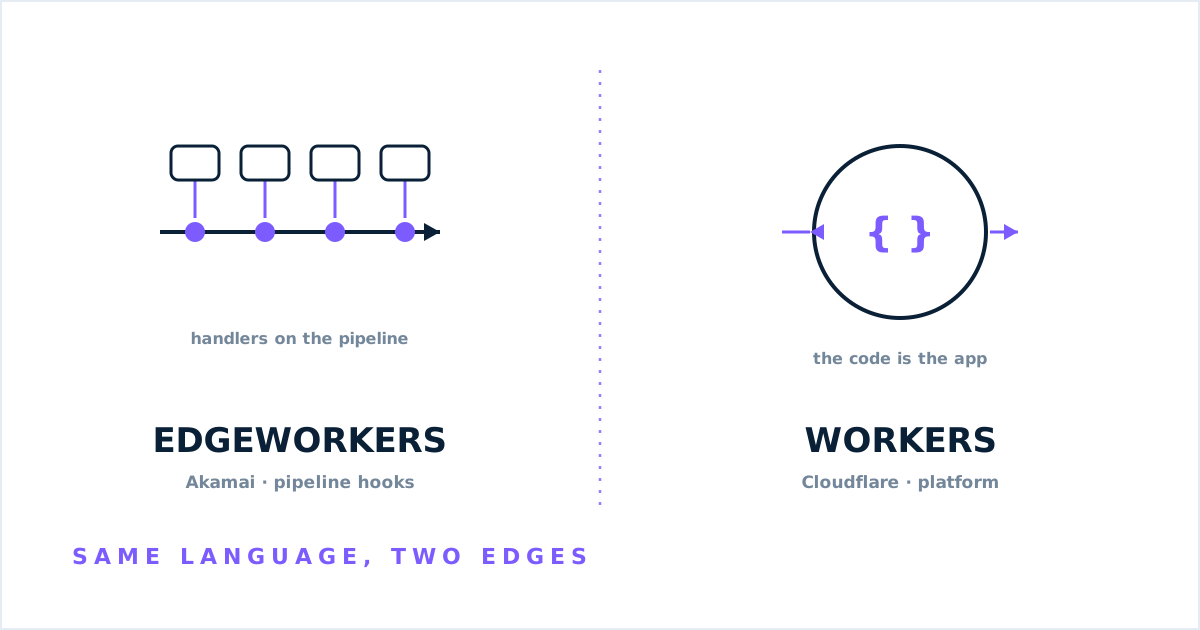
Both run JavaScript at the edge, and the resemblance ends quickly. EdgeWorkers is a set of hooks into Akamai’s delivery pipeline: you implement handlers for named lifecycle events — onClientRequest before cache lookup, onOriginRequest and onOriginResponse around the origin fetch, onClientResponse on the way out, and responseProvider when the worker itself becomes the origin. Workers inverts this: your code receives the request and is the application, with the pipeline abstracted behind a fetch handler. One extends a CDN; the other replaces the server.
Limits reflect the intent
Akamai sizes EdgeWorkers for pipeline logic, not applications: resource tiers — Basic, Dynamic and Enterprise Compute — set per-event-handler CPU and memory ceilings measured in tens of milliseconds and single-digit megabytes, with sub-request wall-time budgets to match. That is ample for the intended work: A/B allocation, token validation, geo redirects, cache-key surgery, header and manifest manipulation. Workers’ ceilings are application-grade: 128 MB per isolate and CPU time from 30 seconds up to five minutes on paid plans, with only CPU (not I/O wait) billed — enough to render pages, resize images or run inference-adjacent workloads. Comparing the limit sheets side by side is the fastest way to see that these products were pointed at different problems. Figures checked against provider documentation, July 2026.
Operations and money
Deployment temperament differs the same way. Workers ships from a CLI to the whole network in seconds, with published pricing anyone can model: a free tier of 100,000 requests/day, then $5/month covering 10 million requests and 30 million CPU-milliseconds. EdgeWorkers deploys as versioned code bundles activated through Property Manager alongside your delivery configuration — more ceremony, but the ceremony is the point: edge code rides the same change-management, testing and rollback discipline as the rest of an enterprise Akamai estate, and billing lands on the same negotiated contract, tier-priced through your account team.
Where each earns its keep
State is the other honest differentiator. EdgeWorkers pairs with EdgeKV, a distributed key-value store sized for the same job the runtime is — configuration, flags, small lookups read at request time. Workers pairs with a whole storage family: KV for the same lightweight reads, R2 for objects with zero egress fees, D1 for relational data, and Durable Objects when logic genuinely needs a single coordinated point of truth. If your edge use case ends at “look something up and branch,” the two are equivalent; the moment it involves writing state that other requests must see, the platforms stop being comparable at all.
If you run Akamai for the reasons covered in Akamai vs CloudFront — footprint, media scale, the security stack — EdgeWorkers is how you personalize and steer that traffic without adding a vendor: request-time logic living millimetres from Bot Manager verdicts and delivery policy. If you are building applications at the edge — APIs, rendering, stateful coordination via Durable Objects — Workers is the platform, and pairing this piece with Fastly Compute vs Cloudflare Workers completes the runtime picture. The anti-pattern is forcing either across the divide: application logic squeezed into per-event millisecond budgets, or a delivery estate’s routing brain living outside the CDN that executes it.
The honest verdict
This matchup is settled by your estate, not by benchmarks. Enterprises deep in Akamai gain more from EdgeWorkers than a feature table suggests, because integration with delivery and security is the product. Teams choosing an edge to build on gain more from Workers, because the ecosystem is the product. Both can be true in one company — and increasingly are.
Deciding where edge logic should live across a multi-CDN estate? The assessment maps your use cases to the right runtime on each network.