
The enterprise-vs-ecosystem decision: negotiated scale against AWS gravity, with the arithmetic that decides it.
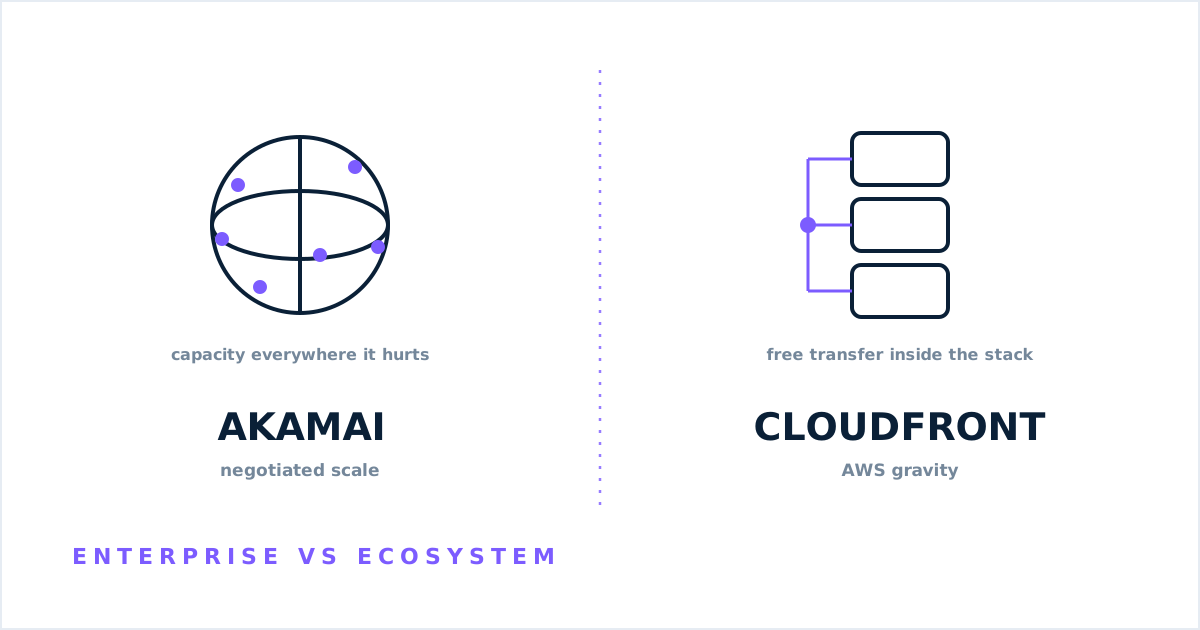
Winner depends on your workload.
Winner depends on: where your origins live, how much traffic sits outside North America and Europe, and whether you have the leverage — or an advisor — to negotiate Akamai’s rate down from list.
Side by side
| Akamai | CloudFront | |
|---|---|---|
| Positioning | Largest, longest-established edge platform | AWS’s CDN, deeply fused with the AWS stack |
| Pricing model | Negotiated commits; list rates are a starting position | Pay-as-you-go from $0.085/GB (US/EU) plus new flat-rate plans |
| Origin economics | Origin egress billed by whoever hosts your origin | Transfer from AWS origins (S3, EC2, ALB) to CloudFront is free |
| Footprint | Thousands of PoPs, strongest reach in hard-to-serve regions | 600+ PoPs plus regional edge caches, strongest in AWS-heavy markets |
| Edge compute | EdgeWorkers (JavaScript, tiered limits) | CloudFront Functions + Lambda@Edge |
| Security | App & API Protector, Bot Manager, Prolexic (separate products) | AWS WAF, Shield; bundled into flat-rate plans |
| Buys well for | Global enterprises, broadcast media, negotiated volume | AWS-native stacks of almost any size |
Two different gravities
This pairing is less a feature fight than a fight between two kinds of gravity. Akamai pulls with scale: a network built over more than two decades, with points of presence in markets most CDNs serve from three countries away, and an enterprise sales motion to match. CloudFront pulls with the AWS bill: if your origins are S3 buckets and load balancers, the transfer from those origins into CloudFront is free, and that one line rewrites the comparison before you look at a single per-GB rate.
Neither pull is wrong. The mistake we see in assessments is applying the wrong one: an AWS-native SaaS paying Akamai list rates for North American traffic, or a broadcaster trying to serve Southeast Asian live audiences from CloudFront alone and wondering why rebuffering spikes.
The pricing arithmetic, shown
CloudFront’s published pay-as-you-go rate starts at $0.085/GB for the first 10 TB a month delivered from US and European edges, stepping down with volume, with an always-free tier of 1 TB and 10 million requests. Rates climb by region — India starts around $0.109/GB and South America around $0.170/GB — and each region’s volume is tiered independently, so a 60/40 US/APAC split blends noticeably higher than the headline number. AWS also now sells flat-rate plans (from a free 100 GB tier up to $1,000/month) that bundle WAF and DNS, aimed squarely at buyers who found the metered model unpredictable.
Akamai publishes no such card. Its delivered rate is a function of committed volume, term, and negotiating position; the same traffic profile can price 2–3× apart between a take-the-quote buyer and a well-benchmarked one. That opacity is not a defect for Akamai — it is the model — but it means a fair comparison needs your numbers, not list prices. Worked example: 200 TB/month, 85% to US/EU, AWS origins. CloudFront: roughly 170 TB at blended ~$0.05–0.06/GB after tiers plus 30 TB at regional rates, order of $11–14k/month, origin fetch free. Akamai can beat that number at commit — but only if the negotiation lands well below list, which is exactly the leverage an independent advisor exists to provide. Figures checked against provider pricing pages, July 2026.
Where Akamai still separates
Three places. First, footprint depth: for audiences in the Middle East, Africa, South Asia and Latin America, Akamai’s in-market capacity is still the safer floor for live events and heavy launch days. Second, media heritage: broadcast-scale delivery, request collapsing under thundering herds, and the operational muscle that comes from decades of carrying the world’s biggest sports nights. Third, the security portfolio — App & API Protector, Bot Manager, and the Prolexic scrubbing network — which is a genuine enterprise stack rather than a bundled feature, as we unpack in our Cloudflare vs Akamai security comparison.
Where CloudFront quietly wins
Inside AWS, CloudFront is very hard to argue with. Free origin transfer from S3 and EC2, IAM-native access control, CloudFormation and CDK support, and edge compute in two sizes — lightweight CloudFront Functions and full Lambda@Edge, a split we cover in detail in CloudFront Functions vs Lambda@Edge. For teams already paying for AWS support and tooling, the marginal operational cost of CloudFront is close to zero, and the new flat-rate plans remove the last excuse — unpredictable bills — that used to push small AWS shops elsewhere.
How to decide
Ask two questions. Where do your origins live? If the answer is overwhelmingly AWS, CloudFront starts with a structural cost advantage that Akamai must out-negotiate to overcome. Where is your hardest audience? If meaningful revenue rides on users in regions where CloudFront thins out, Akamai’s footprint is worth paying for — or worth adding as the second leg of a multi-CDN setup rather than a wholesale switch. Many of our engagements end not with a winner but with a split: CloudFront for AWS-origin static and API traffic, Akamai for the live and long-tail-region layer.
Running AWS origins but eyeing Akamai’s footprint — or the reverse? The assessment prices both against your actual traffic file.