
A CDN trial run casually proves only that the vendor's happy path works. Run as a fourteen-day experiment — real objects, real geography, deliberate failure tests, verdicts written before expiry — it answers the questions the sales call cannot. This is the plan.
Before day 1: know what a trial can prove
Trials vary enormously in what they let you test — quota caps, feature gates, card requirements and durations differ by vendor (our trials comparison maps the field), and enterprise platforms often offer no self-serve trial at all, substituting guided PoCs. Match the trial's shape to your open questions before starting the clock: a 25 GB-capped trial cannot answer throughput questions, and a trial without WAF access cannot answer security ones. If your decisive questions exceed what the trial exposes, negotiate an extended PoC instead — vendors grant them readily to serious evaluators, and the PoC guide covers that track.
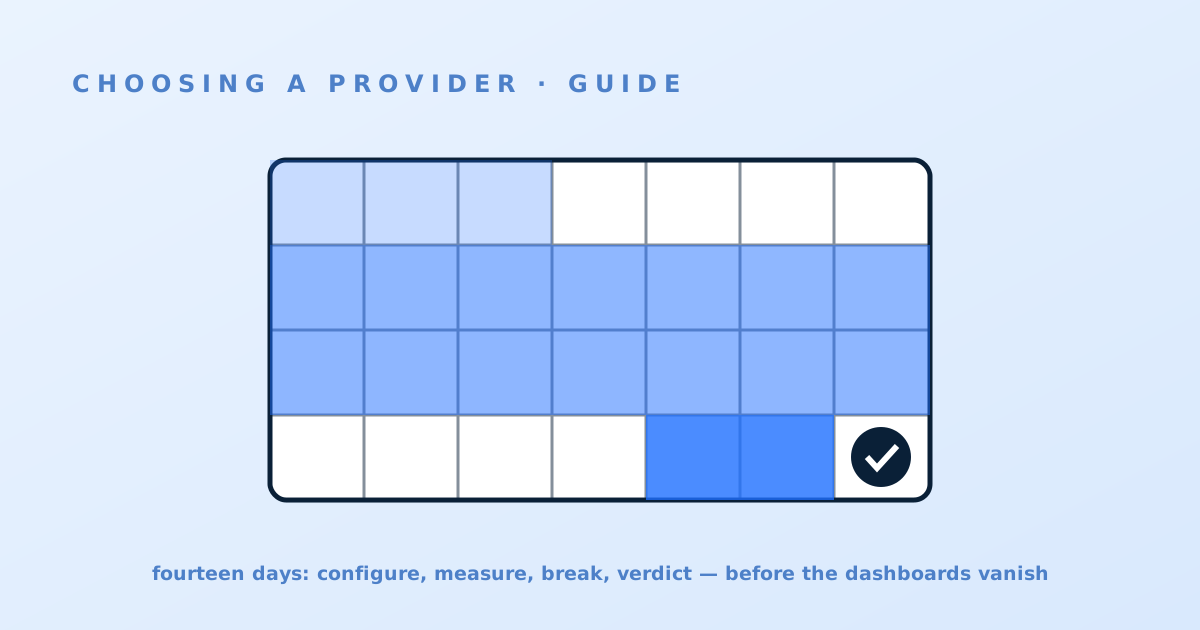
Days 1–3: configure like production
The cardinal trial sin is testing the vendor's demo assets on default settings. Spend the first three days making the trial resemble your production intent: your real origin (or a faithful staging copy), your actual test objects from the benchmark method, TLS on a real hostname you control, cache rules matching your Cache-Control reality, and — critically — the features you intend to buy switched on, because a platform's character shows in how its purge, rules and shield behave together, not separately. Write down every configuration friction you hit; onboarding pain is data, and it predicts what your team lives with for years.
Days 4–10: measure the four things
The middle week is steady-state measurement, ideally with a slice of real traffic (a low-risk hostname, a canary percentage) rather than synthetic load alone. Four measurements decide most evaluations: delivery performance from where your users are (per-city, per-ASN if you can — cloud-vantage numbers flatter everyone); cache behavior under your real object mix (hit ratio trajectory as the cache warms, and what your bill-driving misses look like); origin impact (fetch collapsing, keep-alive behavior, shield effect if enabled); and operational feel — purge latency as you actually experience it, log delivery lag, dashboard truthfulness against your own numbers. Keep a daily one-line log; trends across the week matter more than any single reading.
Days 11–13: break it on purpose
Anyone can serve a cache hit. The trial's highest-value days are the deliberate failures: kill your origin and watch what users receive (serve-stale behavior, error pages, recovery time); push a bad config and measure how fast you can roll it back; purge everything at peak and watch the origin stampede (or the request collapsing that prevents it); expire a certificate on a test hostname if the platform manages certs. Support gets tested here too — file a real ticket at trial-tier support and clock the response, because trial-tier is what your production tier's promises degrade toward under load, per the patterns in the support tiers comparison.
Day 14: write the verdicts
Before access expires — because dashboards and logs vanish with it — export your evidence and write four one-paragraph verdicts: performance (against your baseline numbers, not impressions), operations (the frictions and the failure-day behavior), economics (what the measured cache behavior implies for the real bill), and confidence (what you still cannot know without production traffic). End with a recommendation in one sentence. Two trials run on this plan produce a better decision than five run casually — and the written verdicts become the evidence file your negotiation, and eventually your renewal, will lean on.