
China is the region where CDN marketing and regulation diverge most. Delivery inside the mainland requires licenses most foreign companies do not hold, and every “China acceleration” product is one of three architectures with very different legal and performance profiles. Facts first.
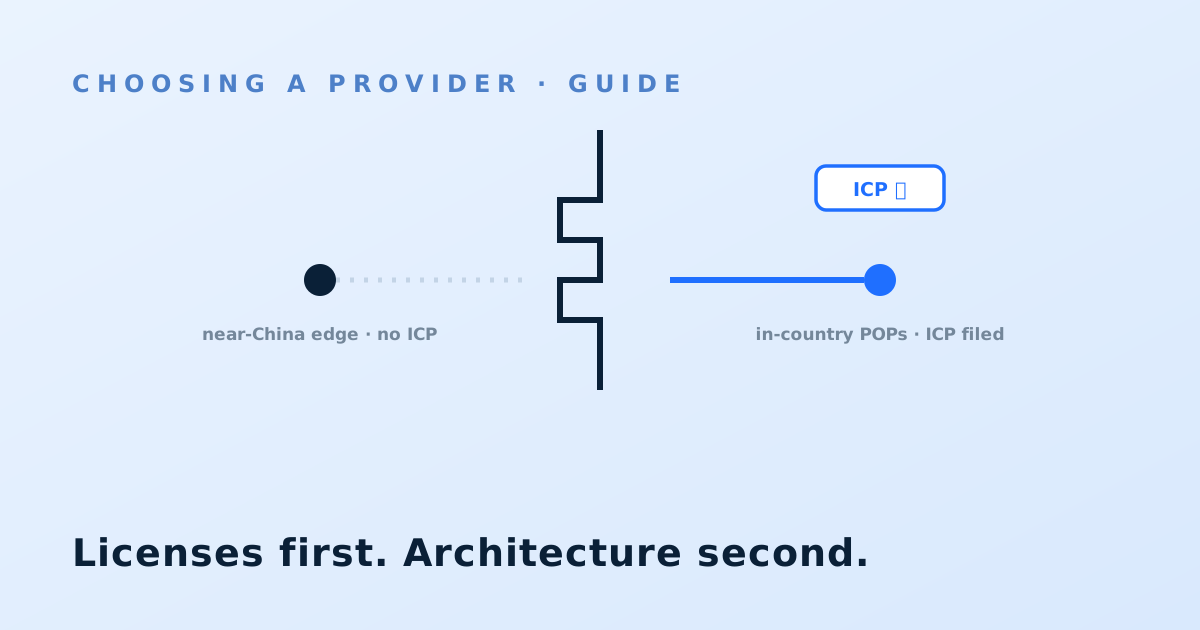
The regulatory floor: ICP
Serving content from servers inside mainland China requires an ICP filing (bei’an) tied to a Chinese business entity, and commercial sites generally need the stronger ICP license. No local entity, no filing; no filing, no mainland hosting — that is the floor, and no CDN can waive it because the requirement attaches to the website, not the infrastructure. Filing timelines run roughly 2–6 weeks once an entity exists; forming the entity is the long pole, typically months. A CDN partner can host the filed presence, but the filing is yours.
Architecture 1: true in-country delivery
POPs inside the mainland, operated by a licensed Chinese CDN (or the China arm of a global one). This is the only architecture that delivers domestic-grade latency — typically 20–50 ms to major cities — and it requires your ICP filing. Providers here include the Chinese majors and the global networks that partner with them; contracts, support and billing often run through the partner, which is worth understanding before an incident, not during one.
Architecture 2: near-China edge
POPs ringed around the mainland — Hong Kong, Taipei, Seoul, Tokyo, Singapore — serving mainland users across the border links. No ICP required, launch this week. The cost is physics plus congestion: cross-border links are the bottleneck, and performance degrades precisely when you care (evenings, holidays, events). Expect 3–10× the latency of in-country delivery and plan for variance, not a number. For many businesses this is the honest interim state while licensing proceeds.
Architecture 3: split the stack
A common production pattern: static assets on near-China edge, the licensed mainland experience (or a partner-hosted mini-site) in-country, and a routing layer sending mainland users to whichever exists. It contains licensing scope to what genuinely needs domestic delivery, and it degrades gracefully if either half has a bad day. It is also the architecture most “we’ll get you into China fast” pitches quietly describe once you read the diagram.
Evaluating claims
Three questions expose most China-delivery pitches. “Where exactly are the POPs serving mainland users — inside or around?” (Ask for city lists, not maps with dots.) “Whose license does traffic ride, and what happens to my delivery if that relationship changes?” And “show me p95 latency from Shanghai and Chengdu residential networks at 8 p.m. local” — the measurement that separates architecture 1 from architecture 2 in one chart. Benchmark from real mainland vantage points before contracting; measurements from Hong Kong are architecture 2 wearing architecture 1’s numbers.