
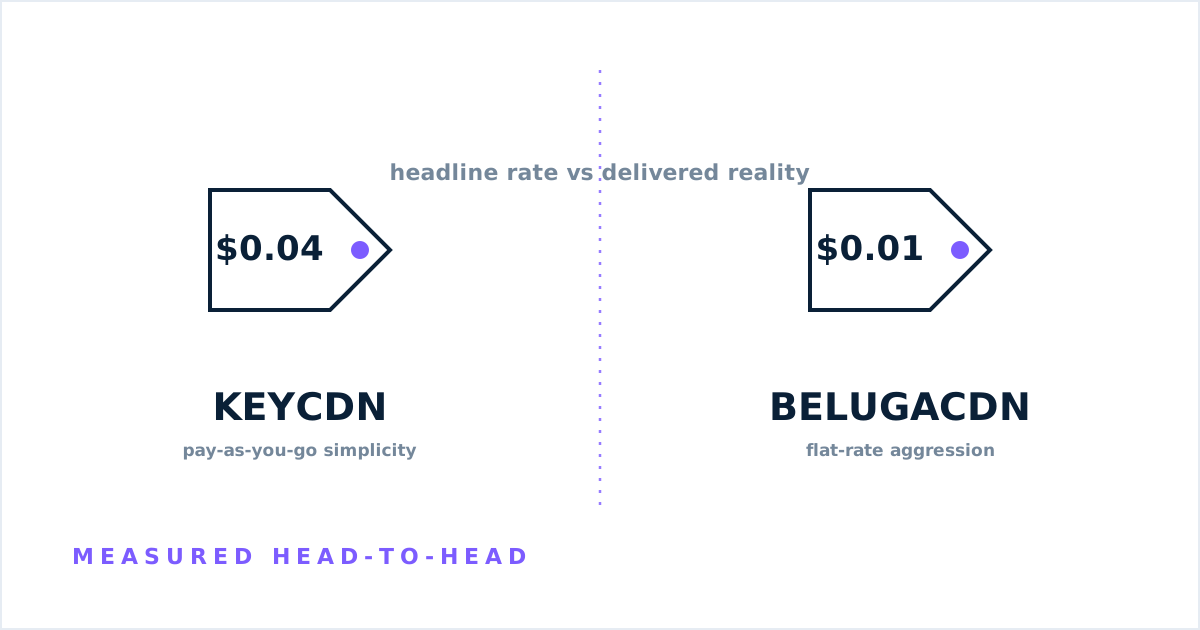
Below the famous value brands runs a leaner tier still: networks run by small teams with small price tags and a philosophy of doing few things properly. KeyCDN and BelugaCDN are its long-standing citizens, and the comparison is a study in deliberate minimalism.
What lean actually means
Modest POP counts placed where traffic statistically lives, essential features executed cleanly, TLS, HTTP/2 and HTTP/3, honest cache controls, simple APIs, and pricing without committee: pay for gigabytes, receive gigabytes. KeyCDN adds image processing and a longer feature sheet; Beluga competes on being the simplest credible network with support that answers.
The performance reality
In well-peered regions both deliver respectable percentiles for static workloads, the physics of a cache near a user is forgiving. The gaps appear at the tails: thin regions, hostile last miles, giant concurrency, exactly where big-network engineering money goes. For blogs, software mirrors, asset offload and modest media, the tails rarely matter; for revenue-critical global products they are the whole conversation.
A pattern worth naming for architects: the lean tier excels as the second network in deliberately boring multi-CDN designs. A primary premium network carrying the critical path, with a lean network holding static long-tail at commodity rates, produces blended economics neither could alone, and the lean vendor’s simplicity becomes an asset, less to configure, less to drift, less to audit. Several of our most cost-efficient client architectures are exactly this shape, and nobody involved apologizes for the unglamorous half.
Operational trade-offs
Fewer features means fewer failure modes and refreshingly short documentation. It also means no enterprise escalation theater when something breaks: you get the actual team, which is wonderful until you need a war room. Sizing that trade honestly is the entire procurement decision at this tier.
In practice
Match the tier to consequence: personal and small-business properties, internal tooling, secondary asset domains and cost-driven offload are natural fits. Anything where an hour of degradation has a P&L line belongs a tier up. Used within its brief, lean delivery is some of the best engineering-per-dollar on the internet.
Curious what your blended rate looks like with a lean network carrying the boring bytes? The assessment models it directly.