
IPv6 in delivery is past the advocacy phase: major mobile networks are v6-dominant, and a meaningful share of your users reach you over it, or try to. The operational questions are narrower than the old debates: is your dual-stack correct, and does it ever cost you latency?
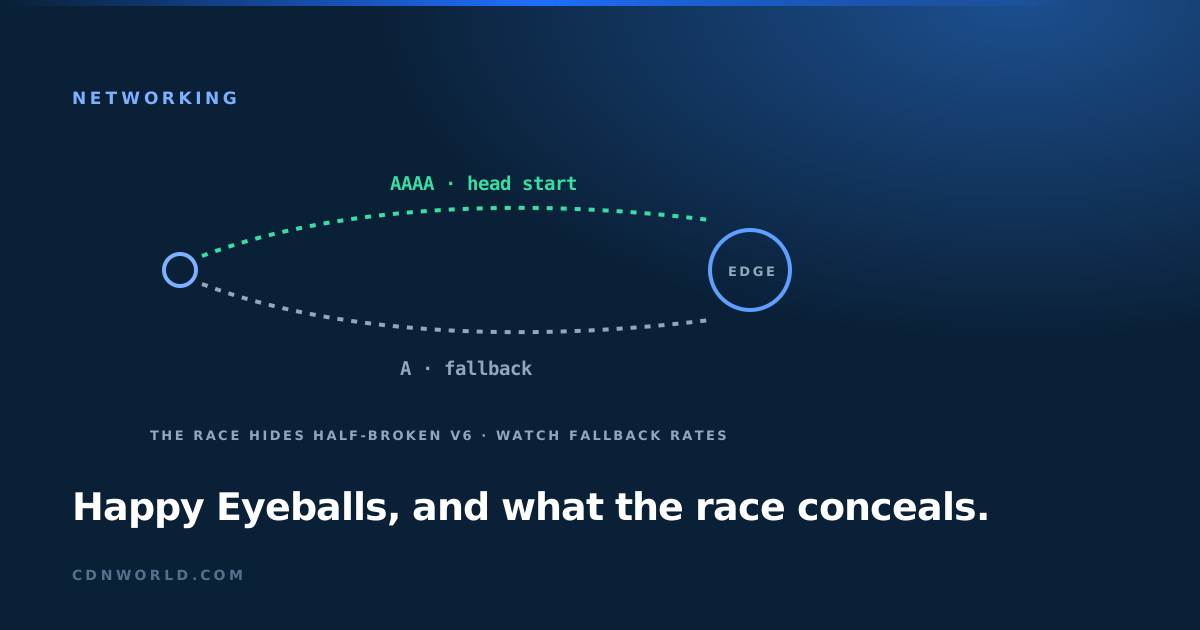
Happy Eyeballs, the racing client
Modern clients resolve both A and AAAA and race connections with a small head start for v6, falling back within milliseconds if it stalls. The design means broken v6 mostly degrades to slightly-slower v4 rather than outages, which is both the safety net and the trap: half-broken v6 hides behind fallback latency, visible only as a mysterious tax on the affected cohort’s connect times. Your RUM’s per-address-family split (collect it) is where this surfaces.
The delivery-layer checklist
CDNs made edge v6 trivial: AAAA records on, done, and the edge speaks v4 to your legacy origin happily. The estate-side gaps that persist: apex records missing AAAA while www has it (or the reverse), certificate automation validating over one family only, origin firewalls surprising the CDN’s v6 fetch ranges, and geolocation or ACL logic built on v4 assumptions misclassifying v6 users. Each is an afternoon to find and fix; each ships broken somewhere in most large estates.
One forward note keeps this strategic: carrier-grade NAT on v4 is quietly degrading the old default, shared v4 addresses complicate rate limiting, abuse attribution, and geolocation (our rate-limiting article’s NAT caveat is mostly a v4 story), while v6 restores per-device addressing with all the policy precision that returns. Estates doing serious per-client work at the edge, limits, personalization, fraud signals, increasingly find v6 traffic is their cleaner signal, and design keys accordingly (prefix-aware for v6 privacy rotation, token-first everywhere). The address family stopped being a compliance checkbox and became an input to policy quality, which is the sort of promotion infrastructure details earn quietly.
The performance reality
Path quality per family varies by network: v6 is sometimes faster (cleaner paths, no CGNAT), sometimes slower (less-optimized peering), and the deltas are cohort-specific rather than universal. Measure rather than believe: per-family connect-time percentiles by network, from RUM. Where v6 measurably lags for a major cohort, that is a peering conversation with your provider, armed with your data, the recurring posture of this series.
In practice
Enable AAAA at the edge if you somehow haven’t, add address family to RUM attribution, audit the estate checklist above, and watch fallback rates: rising Happy-Eyeballs fallback is an early-warning indicator of v6 path trouble that users never report because nothing visibly fails. Dual-stack done properly is unremarkable, which is precisely the target state.
Dual-stack audits ride along with delivery reviews here: estate checklist, per-family RUM splits, fallback-rate baseline.