
The category’s two biggest pure-plays compared: HUMAN’s breadth from ad fraud to account abuse against DataDome’s focused real-time engine.
Winner depends on your workload.
Winner depends on: whether you’re buying one platform for the whole fraud surface — bots, ads, accounts, agents (HUMAN’s breadth) — or the sharpest dedicated engine for automated traffic itself (DataDome’s focus); team shape decides as often as detection.
Side by side
| HUMAN Security | DataDome | |
|---|---|---|
| Heritage | White Ops; merged with PerimeterX (2022) | French-founded specialist; EU heritage |
| Analyst status | Forrester Wave Q2 2026 Leader | Forrester Wave Q2 2026 Leader |
| Scope | Sightline platform: bots, ad fraud, account fraud, agentic trust | Bot & agent trust, L7 DDoS, ad and account fraud modules |
| Signature strength | Threat research & takedowns; attack-profile analytics | ~2 ms real-time decisions; API & mobile depth; fast deployment |
| Noted critiques | Management UI “mixed”; data access wish-listed | Not a full fraud platform for human-led fraud scenarios |
| Pricing | Enterprise-quoted | Published tiers from ~$3.8k/month; enterprise above |
Two Leaders, one renamed category
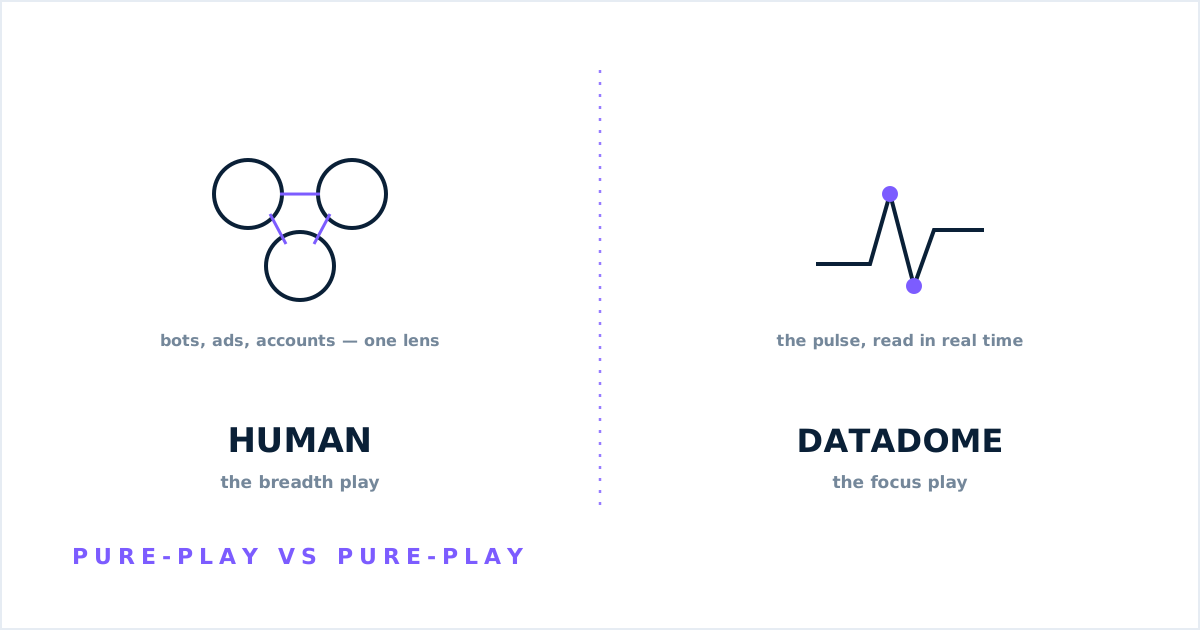
Forrester’s Q2 2026 Wave renamed the category to Bot and Agent Trust Management and named both of these vendors Leaders — fittingly, since between them they define its poles. HUMAN Security, born as White Ops and enlarged by the 2022 PerimeterX merger, is the breadth play: one platform (Sightline) spanning bot defense, ad-fraud verification, account-fraud detection and now agentic-trust governance. DataDome is the focus play: a real-time engine for adjudicating automated traffic, sharpened rather than widened. Both stop the attacks in their overlapping core; the buying decision lives in the edges.
HUMAN’s case: the whole fraud surface
HUMAN’s distinguishing assets are scope and research. The PerimeterX merger fused first-rate web and mobile bot defense with White Ops’ ad-fraud pedigree — the team behind some of the industry’s most public botnet takedowns — so a marketplace can buy bot mitigation, ad verification and account protection as one platform with one intelligence backbone. Forrester’s evaluation credits exactly that: rich attack-profile analytics, a deep out-of-the-box AI-agent library, a considered trust-governance vision. Reference customers’ critiques are operational rather than fundamental — a management UI graded “mixed,” data access that could be easier — the classic texture of a platform assembled from strong parts. Its natural buyer runs advertising and marketplace risk in the same meeting as bot defense.
DataDome’s case: the sharpest engine
DataDome’s counter is what focus buys: decisions in roughly two milliseconds, models fed by trillions of daily signals, notable depth on the API and mobile surfaces where modern automation actually arrives, and deployment modules for effectively any architecture — the same any-CDN freedom that framed DataDome vs Cloudflare Bot Management. Its published pricing (tiers from about $3,800 a month) makes procurement unusually friction-free for the category, and its reviewers repeatedly cite time-to-value: days to full blocking, not quarters. The honest boundary: DataDome adjudicates traffic brilliantly but is not a whole-fraud platform — estates fighting human-led account fraud typically pair it with dedicated fraud tooling. Figures checked against provider documentation, July 2026.
Where the bake-offs actually turn
Run both on your login, checkout and API flows and the detection scores will likely be close — they are Leaders for a reason. The separators, per buyers we’ve debriefed: HUMAN wins when ad-fraud budgets co-fund the purchase, when threat-research access matters to the security team, and when one vendor across the fraud surface simplifies governance. DataDome wins on deployment speed, API/mobile-first estates, EU-friendly posture, and when a fraud team wants a razor rather than a Swiss Army knife. Both are US-headquartered platforms operationally; European buyers with hard residency requirements should probe processing locations in contract, a theme Myra vs Link11 makes central.
How to decide
Draw your org chart before your shortlist. If bot defense, ad verification and account integrity report to one risk owner, HUMAN’s consolidated platform matches the structure and the intelligence sharing pays compounding dividends. If a product-security or anti-bot team owns this fight specifically, DataDome’s engine gives them the fastest, most controllable instrument. And whichever way you lean, insist on a production-mirroring trial scored on your false positives — in this category, a blocked customer costs more than the license.
Choosing between the category’s pure-plays? The assessment scores both engines on your real login and checkout traffic.