
A checkbox on Google’s load balancer against a full edge platform — what the flat-rate model changes for GCP estates.
Winner depends on your workload.
Winner depends on: whether you are buying delivery for a GCP application or an edge platform for a business — and how much of your bill is egress that Cloudflare’s model simply doesn’t meter.
Side by side
| Google Cloud CDN | Cloudflare | |
|---|---|---|
| Model | Metered: cache egress + fill + lookups | Flat plans (Free/$20/$200/Enterprise); bandwidth unmetered |
| Egress (NA/EU) | $0.08/GB → $0.02/GB above 500 TB | Not billed on standard plans |
| Origin coupling | Requires Google global external load balancer | Works in front of any origin, any cloud |
| Security | Cloud Armor (separate, metered) | DDoS unmetered all plans; WAF from Pro; Bot Mgmt Enterprise |
| Edge compute | None in-product | Workers — free tier, then $5/month baseline |
| Ops surface | Thin: cache modes, invalidation | Broad: rules, Workers, R2, images, load balancing |
A checkbox versus a platform
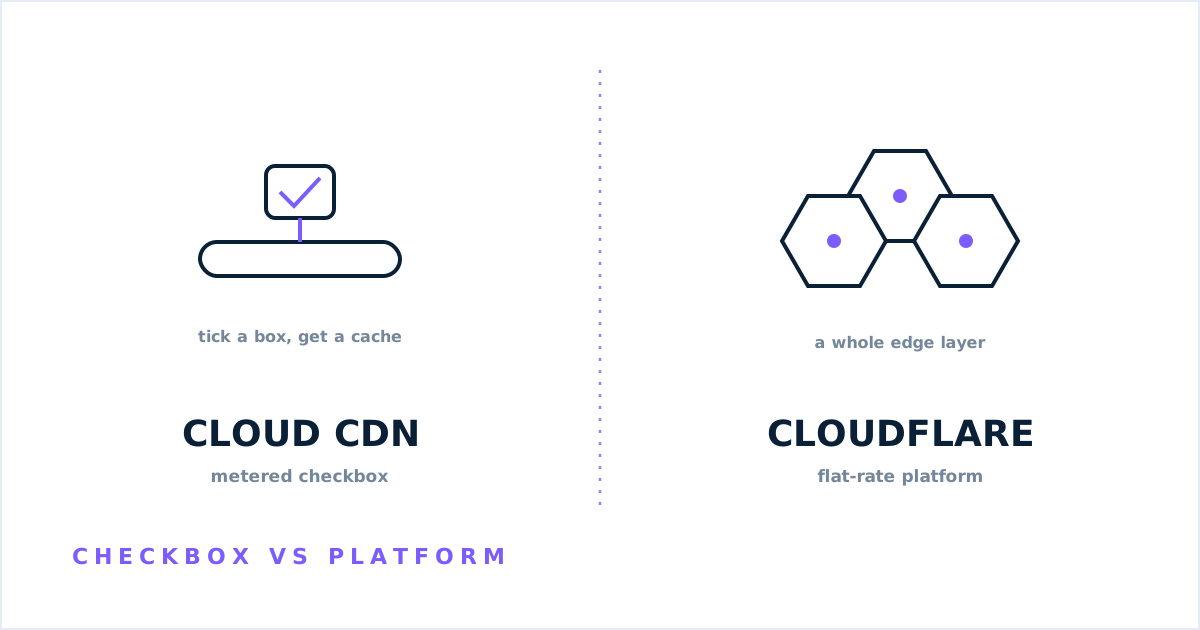
Google Cloud CDN is a feature you enable on infrastructure you already run: flip caching on the global external load balancer and GCP traffic rides Google’s backbone with almost no new operational surface. Cloudflare is a company you put in front of your company: DNS, delivery, security, compute and storage on one network, priced mostly flat. Comparing them is really comparing a line item against a layer — which is exactly why so many GCP estates end up running both.
The money question: metered vs flat
Cloud CDN meters three things: cache egress from $0.08/GB in NA/EU (falling to $0.02/GB above 500 TB/month), cache fill at $0.01–$0.08/GB on misses, and lookups at $0.0075 per 10,000 requests. Cloudflare’s standard plans meter none of them: Free, Pro ($20/month) and Business ($200/month) carry unmetered bandwidth, with Enterprise moving to negotiated terms. Worked example: 40 TB/month of cacheable NA/EU traffic from a GCS origin. Cloud CDN: roughly $3,200 cache egress + ~$120 lookups + modest fill ≈ $3,300–3,400. Cloudflare Business: $200 — plus whatever GCP charges to get miss traffic out to Cloudflare, which at a 95% hit ratio is about 2 TB of GCP network egress. The arithmetic is brutal at volume, and it is why “GCP origin, Cloudflare front” is one of the most common architectures we audit. Figures checked against provider pricing pages, July 2026.
The honest caveat: unmetered is a policy, not physics. Push enough video through a $200 plan and the conversation becomes an Enterprise negotiation — still usually favorable, but no longer $200.
What Cloudflare adds beyond delivery
The gap widens away from caching. Cloudflare bundles unmetered DDoS mitigation at every tier, a WAF from the Pro plan, and a programmable edge in Workers — compared in depth in Fastly Compute vs Cloudflare Workers — plus R2 storage with zero egress fees. Google’s answers live in separate products: Cloud Armor for WAF and DDoS (metered per policy and per million requests), Media CDN for media-grade delivery, and application code for edge logic. Each is credible; the sum is more procurement and more meters.
What Cloud CDN does better
Inside a GCP-only estate, simplicity wins real arguments: no extra vendor, IAM-native controls, logs in Cloud Logging, latency on Google’s premium backbone, and — for teams already committed to Google’s load balancer — effectively zero adoption cost. There is also a governance case: one cloud bill, one support contract, one compliance review. For internal tools, moderate-traffic applications and anything where the CDN line is noise, adding Cloudflare is complexity without payoff — a mirror of the conclusion in CloudFront vs Google Cloud CDN.
How to decide
Size the egress line. If delivery egress is a rounding error, stay native — Cloud CDN’s thinness is a feature. If egress is a visible percentage of your GCP bill, price the Cloudflare-in-front pattern: the flat model plus zero-egress R2 for static assets routinely cuts the delivery line by half or more, at the cost of a second vendor and a second config surface. And if you are Enterprise-scale on both, negotiate them against each other — that leverage is precisely what an independent advisor is for.
GCP estate with a growing egress line? The assessment prices native delivery against the Cloudflare-in-front pattern on your numbers.