
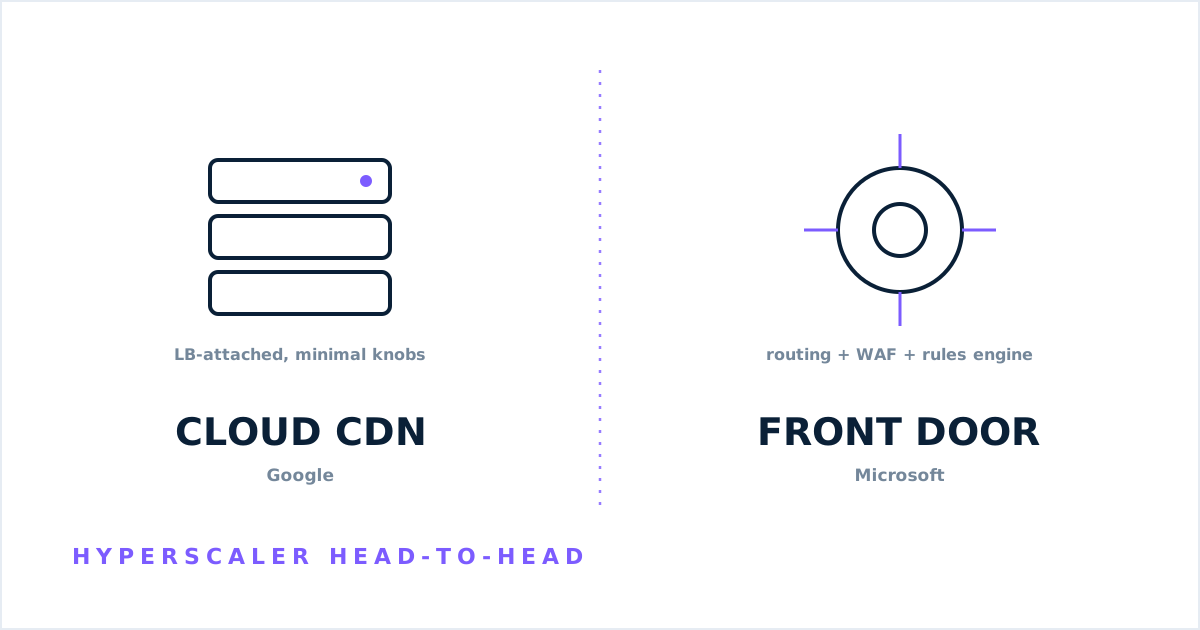
Neither of these products is a CDN in the classic standalone sense, and that is exactly what makes the comparison instructive. Google Cloud CDN is caching attached to Google’s global load balancer; Azure Front Door is Microsoft’s integrated global entry point with CDN, WAF and routing fused together.
Architectural intent
Google’s design assumes your origin lives behind its global external load balancer: enable caching and your traffic rides Google’s premium backbone and edge. It is elegant, fast and deliberately thin on CDN-specific features. Front Door assumes you want one global L7 layer for everything: TLS termination, path routing, WAF policy, caching and origin failover in a single Microsoft-managed front end with deep Azure integration.
Feature depth and control
Front Door offers more knobs: rules engine, per-route policies, private link to origins, integrated WAF tiers. Google’s offering keeps the surface small, with cache modes and negative caching but little of the rules-engine sprawl; sophisticated logic is expected to live in Cloud Armor, Media CDN, its separate media-grade sibling, or your application. Teams wanting a programmable edge on Google increasingly look at Media CDN or a third-party overlay.
One historical footnote that still bites Azure estates: classic Azure CDN profiles built on third-party networks are a legacy with a hard ending, after the Edgio bankruptcy forced migrations in early 2025, Microsoft’s direction consolidated firmly on Front Door. Any architecture document still referencing Azure CDN Standard from those lineages is describing infrastructure that no longer exists, and inherited configurations deserve an audit rather than an assumption. The consolidation simplified Microsoft’s story and quietly deleted several pricing tiers buyers used to arbitrage.
The ecosystem calculus
Both products price attractively inside their clouds and awkwardly outside them. Cross-cloud origins work but surrender the egress advantages that justify the choice. The honest framing: these are excellent defaults for single-cloud estates and mediocre standalone CDNs, which is not a criticism, it is the design brief.
In practice
If your stack is GCP-native with straightforward caching needs, Cloud CDN is nearly free to adopt and hard to beat operationally. If you are Azure-centric and want one managed front door with WAF included, Front Door Standard or Premium earns its place. If your requirements outgrow either, media scale, fine cache control, multi-cloud, that is precisely where the specialist networks re-enter the conversation.
Running one of these inside a multi-cloud estate? The assessment models where the hyperscaler edge ends and a specialist earns its keep.