
Search visibility has an infrastructure substrate nobody in the SEO meeting owns: crawlers experience your delivery layer before your content, and their experience, latency, errors, redirects, consistency, shapes how much of your estate gets indexed and how fresh it stays. Several CDN settings are SEO settings wearing engineering clothes.
How crawl budget actually responds
Major crawlers adapt their request rate to your responsiveness: fast, error-free responses invite deeper crawling; rising latency and 5xx rates throttle it, the crawler politely backing off exactly when your estate has problems, compounding an incident’s cost with staleness in the index. Server errors and timeouts also burn budget on retries. The delivery consequences write themselves: the cache-hit, stale-if-error, origin-shielded architecture this series builds is also crawl-capacity engineering, bots hitting cache cost you nothing and crawl deeper.
The bot-management tightrope
The same layers that classify automation (our fingerprinting article) must whitelist the automation you want: search crawlers verified properly, reverse-DNS and published verification methods, not spoofable user-agent strings, since scrapers impersonate crawlers precisely because estates whitelist carelessly. Challenge pages served to real crawlers are indexing poison; over-aggressive rate limits on crawler ranges quietly cap your index freshness. Audit what your edge actually serves to verified crawler traffic, it is a log query, and estates are routinely surprised.
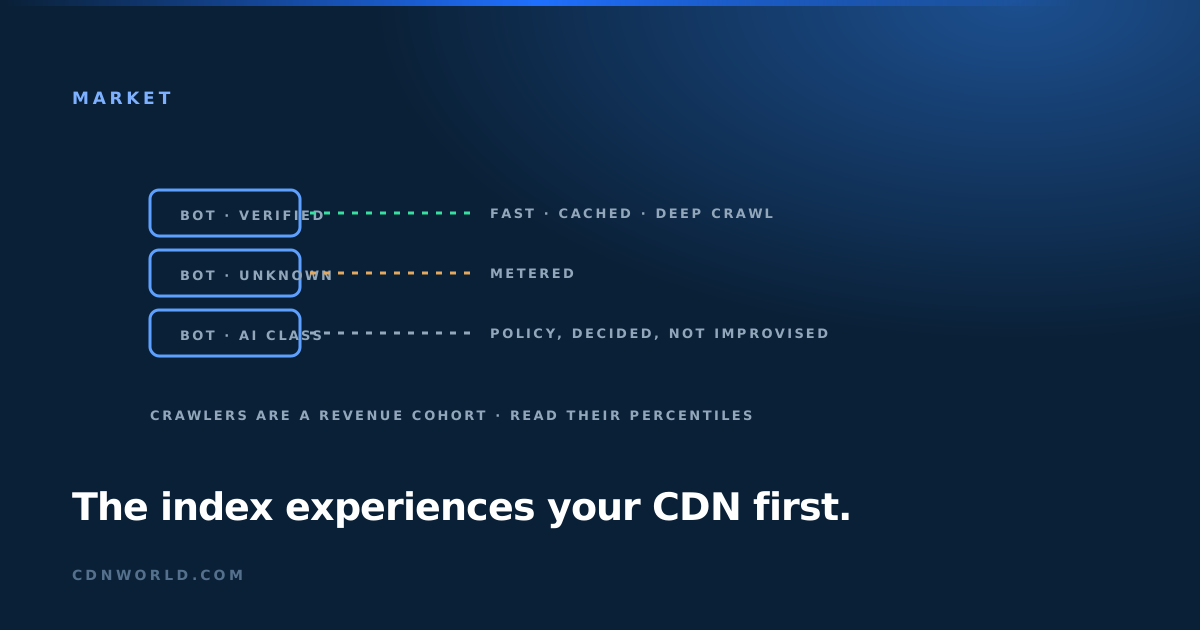
The AI-crawler complication is the current chapter: a new population of bots, model-training collectors, retrieval agents, answer-engine indexers, now consumes estates at scale, and their value exchange differs sharply from search’s classic traffic-for-crawling bargain. Delivery layers have become the policy instrument: per-bot-class rules (verified identities where the operators publish them), differentiated rate limits, paths welcomed or fenced, and emerging standards for machine-readable permissions all execute at the edge. Estates should decide their AI-crawler policy deliberately, whom to feed, whom to meter, whom to block, and encode it where enforcement is real, because the default is whatever your bot layer improvises, and improvised policy is how estates discover they had one only after it mattered.
The consistency requirements
Crawlers are sensitive to what varies: redirect chains cost budget per hop (flatten them at the edge); mobile and desktop parity matters under mobile-first indexing (device-based edge logic must not fork content quality); geo-steering must not show crawlers a different site than users (crawl origins are geographically concentrated, and naive geo-personalization localizes your index to the crawler’s vantage); and soft-404s, error pages returning 200, teach the index your failure page is content. Each is an edge-configuration review item with organic-traffic consequences.
In practice
Quarterly, run the crawler-experience audit: filter verified-crawler traffic in your unified logs and read its status distribution, latency percentiles, cache-hit rate and challenge-page exposure as if it were a user cohort, because for revenue purposes it is one. Fix the redirect chains, verify the whitelisting, and put crawler 5xx-rate on an alarm. The organic channel’s infrastructure dependency is real, measurable and almost always unowned; owning it is free ranking hygiene.
Crawler-experience audits here treat bots as a revenue cohort: status, latency, cache and policy, with the AI-crawler stance made explicit.