
Inside every POP is a cluster of cache servers and an unglamorous question: which machine holds which object? The answer, consistent hashing, is one of the quiet algorithms that makes planetary caching viable, and its properties explain several behaviors operators observe from outside.
The problem naive hashing has
Hash the object key modulo the server count and everything works until the server count changes: one node added or removed remaps nearly every key, and the whole cluster’s cache effectively empties at once, a self-inflicted stampede. Clusters change constantly, deploys, failures, scaling, so modulo hashing is an outage generator wearing an algorithm’s clothes.
The consistent-hashing fix
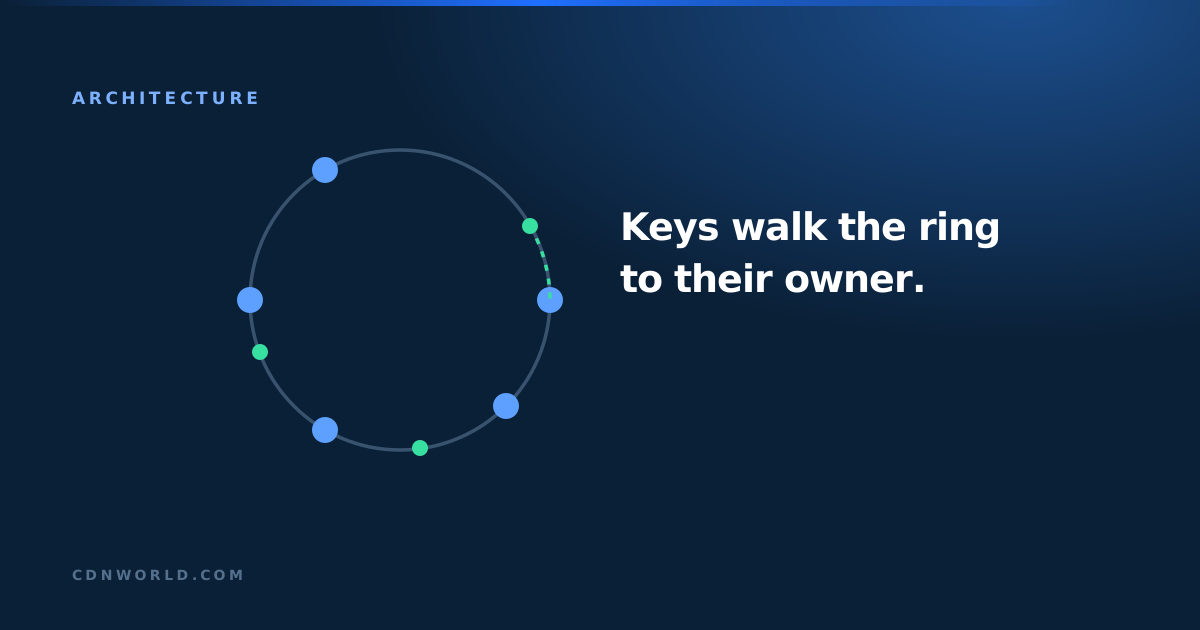
Map servers and keys onto the same hash ring; each key belongs to the next server clockwise. A node’s departure remaps only its own arc, a joiner steals only the arc it lands on: disruption proportional to the change, not the cluster. Virtual nodes, each server appearing many times on the ring, smooth the load distribution, and bounded-load variants cap any server’s share so hot arcs cannot overload one machine while neighbors idle.
The multi-layer picture ties the series together: a request may traverse anycast to a POP, consistent hashing to an owner node, miss to a shield tier with its own ring, coalesce with identical requests, and fetch origin exactly once, five algorithms deep before your server hears anything. Each layer exists to absorb a specific failure of the naive design, and each is invisible until it is the explanation. Operators who hold this stack in their heads debug delivery incidents in minutes, because where a symptom appears tells them which layer to interrogate. That mental model, more than any tool, is what this engineering series is trying to install.
Hot keys and the layers above
Consistent hashing concentrates each object on one owner, which is efficiency until one object is the internet’s obsession that hour. Production systems layer fixes: tiny hot-object caches on every node in front of ownership routing, request coalescing at the owner, and replication factors for the head of the popularity curve. The visible symptom when this layering is weak: single objects whose latency degrades under load while the POP overall looks healthy.
In practice
You do not configure any of this, but you can reason with it: per-object performance anomalies under viral load are often ownership hot-spotting; cache-efficiency dips during provider maintenance windows are ring reshuffles; and vendors’ answers about hot-object handling and intra-POP replication reveal cluster engineering depth quickly. It is also the same algorithm you will reach for in your own infrastructure the day you shard anything, which makes it doubly worth knowing cold.
Want the stack mapped for your traffic specifically? The technical assessment draws it with your numbers on it.