
Product against product: the two most-shortlisted WAFs compared on detection engines, tuning burden, limits and the buying experience.
Winner depends on your workload.
Winner depends on: whether your estate is best served by collective-intelligence rules that deploy in seconds and tune easily, or by a self-adapting engine built for hundreds of properties — and whether your procurement can stomach an enterprise-only sales cycle.
Side by side
| Cloudflare WAF | Akamai App & API Protector | |
|---|---|---|
| Detection core | Managed rulesets + ML scoring, fed by network-wide attack telemetry | Adaptive Security Engine — self-tuning per endpoint over time |
| Rule deployment | Seconds, self-service, from the Pro plan up | Property activation cycle; enterprise change management |
| False-positive posture | Low, with easy per-rule overrides | Repeatedly near-zero in independent test cycles |
| API security | API Shield: discovery, schema validation, mTLS, GraphQL limits | Noname-based behavioral API detection built in |
| Known limits | 128 KB inspected payload on non-Enterprise plans | Deployment weight; partner/services-led rollouts common |
| Buying | Self-serve tiers ($20 / $200) → Enterprise quote | Enterprise-only; typically part of a $50k+/yr security contract |
Product-level, not stack-level
We compared these vendors’ full security stacks — DDoS, bots, the works — in Cloudflare vs Akamai security stacks. This piece narrows to the WAF products themselves, because that is where most shortlists actually collide: Cloudflare’s WAF as the reachable default, App & API Protector as the enterprise incumbent-killer. The engines, the tuning burden and the buying motion differ enough that the right answer is rarely obvious from a features grid.
Detection engines, compared honestly
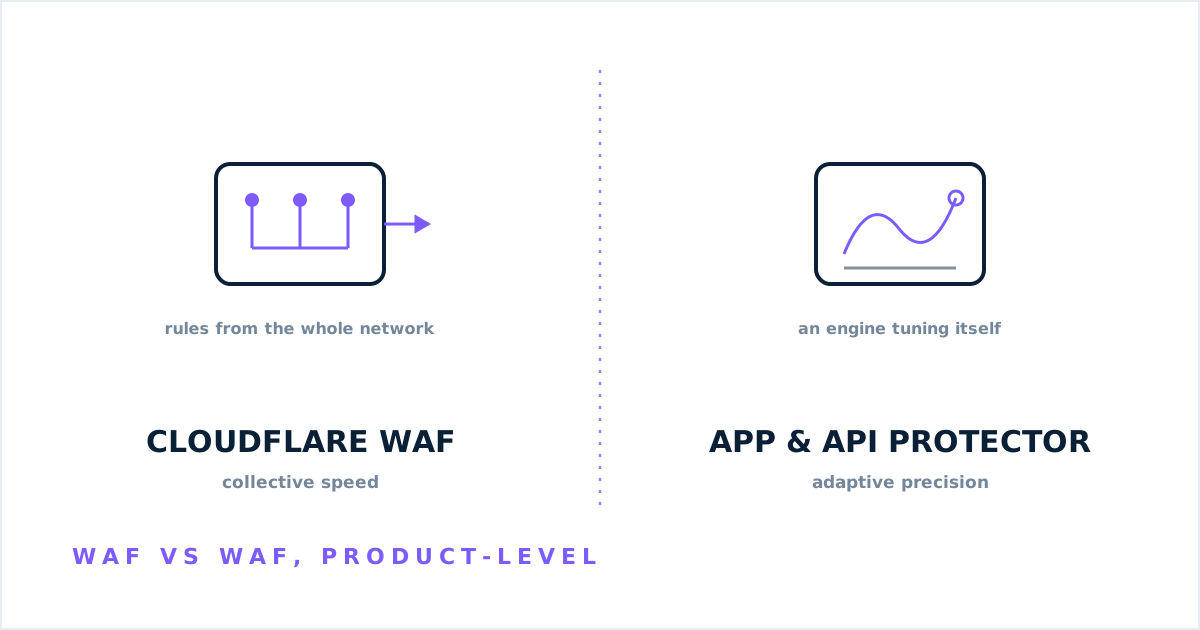
Cloudflare’s WAF layers managed rulesets over machine-learned attack scoring, with its decisive advantage being telemetry: a signature or bypass observed anywhere on a network fronting a meaningful share of the web propagates protection to every customer, fast. Akamai’s Adaptive Security Engine takes the opposite bet: rather than shipping rules outward, it tunes itself inward — learning each protected endpoint’s traffic and adjusting sensitivity per property, which is how it keeps posting near-zero false-positive rates in independent test cycles while maintaining high detection. Both engines clear the OWASP bar comfortably; they diverge on philosophy. Cloudflare optimizes for speed of collective response, Akamai for precision on estates too large to hand-tune.
The tuning tax, where WAF costs really live
Ask any operator: WAF cost is measured in analyst hours, not license fees. Cloudflare’s tuning loop is famously short — a false positive traced in the dashboard, a rule exception shipped in seconds, all self-service from the $20 Pro plan upward. Akamai’s loop is heavier at the front (deployments ride Property Manager activations, and most estates land with partner or professional-services help) but lighter at steady state: the engine’s self-tuning is precisely designed to make a 400-property estate manageable without 400 rule sets. Two practical limits belong in any evaluation: Cloudflare inspects request payloads up to 128 KB on non-Enterprise plans — relevant for large-body APIs — and Akamai’s change-management ceremony, a feature for regulated estates, is friction for teams used to shipping edge config hourly.
APIs, the sharper test
Modern WAF shortlists are increasingly decided on API protection. Cloudflare’s API Shield covers discovery, positive-security schema enforcement against OpenAPI contracts, mutual TLS and unusually mature GraphQL controls. Akamai folded the acquired Noname technology into App & API Protector, adding session-level behavioral detection — the layer that catches credentialed, low-and-slow abuse request-scoped rules miss. Teams with account-takeover exposure and sprawling REST estates tend to grade Akamai ahead here; API-first platforms that live in OpenAPI specs tend to find Cloudflare’s tooling faster to operationalize.
How to decide
Match the product to your operating model. If your security team ships changes like a product team — fast loops, self-service, one to a few dozen properties — Cloudflare’s WAF delivers the most protection per analyst hour, at a price you can read on a webpage. If you run hundreds of properties under compliance regimes, with fraud-grade adversaries and a procurement function that expects a sales cycle, App & API Protector’s precision and self-tuning justify the enterprise weight. And in either case, negotiate: at Enterprise tier both products price like the relationship, not the SKU — which is exactly where independent benchmarks earn their keep.
Shortlisting WAFs for a renewal or an RFP? The assessment scores both engines against your traffic and your team’s operating model.