
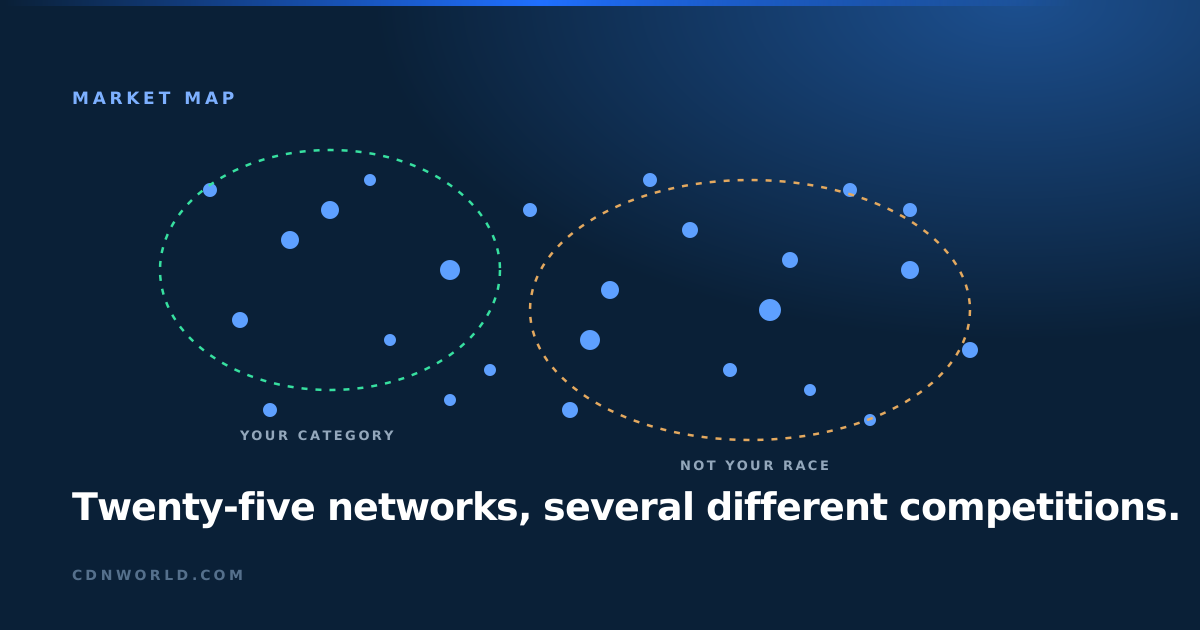
Provider lists treat the market as one ladder. It is really several distinct competitions, and knowing which one your workload belongs to shortens every decision that follows.
The enterprise heavyweights
Akamai, Cloudflare and Fastly compete on breadth: global scale, security depth, edge compute. They win where requirements are complex and the cost of failure dwarfs the delivery bill. Their list prices assume you need what they bundle. The ladder framing fails because it implies every provider wants every workload, when most networks are optimized, commercially and technically, for a specific slice of the market.
The value and regional tiers
CDN77, Bunny, KeyCDN and peers compete on delivered gigabytes per dollar, and do it credibly for static and media workloads. Regional champions, CDNetworks across Asia foremost, win where their network is dense and the giants are thin. Hyperscaler CDNs, CloudFront chief among them, win by ecosystem gravity more than by measurement. Ecosystem gravity deserves respect as a real force rather than dismissal as laziness: integration costs are genuine, and defaulting to the adjacent option is sometimes the correct engineering economics. The error is defaulting without pricing the default.
The map also shifts underfoot, which is why its date matters. Networks invest regionally in visible cycles: a provider thin in South America this year may be dense there in two, and consolidation keeps rearranging the mid-market. Treat any landscape, ours included, as a photograph rather than a portrait: accurate at the shutter, aging predictably. The practical discipline is re-checking the two or three providers adjacent to your shortlist at each renewal, because the challenger that was not ready last cycle is precisely the one most likely to have spent the interval fixing that.
Reading the map
The practical use of the landscape is elimination: most workloads can strike out half the market on region, security needs or pricing model alone. What remains is a shortlist worth actually benchmarking. Elimination also protects attention, the scarcest procurement resource. Deep evaluation of two right-category providers beats shallow evaluation of eight, every time it has been tried.
In practice
Use the map in one sitting: list your regions by revenue, your must-have security features and your traffic shape, then strike out every provider weak on any of the three. What remains is rarely more than three names. If it is zero names, your requirements are contradictory, which is also worth learning before the RFP goes out.
Our index tracks all of them continuously. The assessment turns the map into a shortlist for your traffic specifically.