
The anycast pioneer against the real-time edge — two performance-first networks compared on the metric CacheFly stakes its name on.
Winner depends on your workload.
Winner depends on: whether your bottleneck is sustained throughput on large objects (CacheFly’s home game) or programmable, observable delivery with instant control (Fastly’s) — and which contract shape your finance team can live with.
Side by side
| CacheFly | Fastly | |
|---|---|---|
| Heritage | 2002; first TCP-anycast CDN | 2011; real-time, developer-led edge |
| Design center | Throughput — large files, video, podcasts, game delivery | Control — instant config, VCL/Compute, real-time logs |
| Network | 50–60+ PoPs, 6 continents; direct-connect options | Fewer, very large PoPs; strongest NA/EU |
| Purge / config | Standard purge tooling | ~150 ms mean purge; config deploys in seconds |
| Programmability | Edge app platform (add-on) | Compute (WebAssembly), first-class |
| Pricing shape | Custom above 100 TB/mo; month-to-month friendly; 100% uptime SLA posture | Usage-based from ~$0.12/GB posture + request fees; commits negotiated |
Two definitions of “fast”
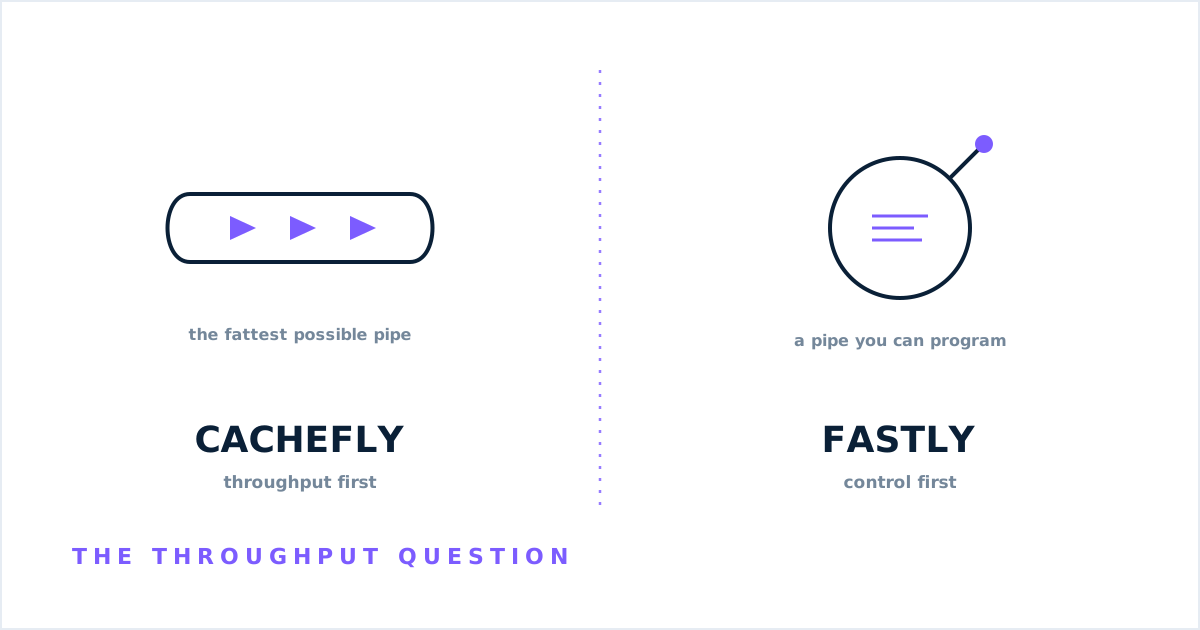
Both networks market performance; they mean different things by it. CacheFly — which built the first TCP-anycast CDN back in 2002 — optimizes for throughput: how many megabits per second a single user actually sustains pulling a large object, which is the metric that decides download times, video start-and-sustain, and podcast delivery. Fastly optimizes for control latency: config changes live in seconds, purges propagating with a mean around 150 milliseconds, logs streaming in real time. One makes the pipe fat; the other makes the pipe obedient. Which “fast” you need is the whole comparison.
The throughput case
CacheFly’s architecture choices all point the same direction: anycast routing that self-heals around failures without a routing brain in the way, a network sized for sustained large-object transfer rather than maximal PoP count, direct-connect options into dozens of data centers to fatten the origin path, and a storage-based origin shield (its S.O.S. product) that pins content at the edge for a near-total cache-hit ratio — which doubles as an egress-fee killer for S3-style origins. The company has ranked at or near the top of third-party speed indices for years — a claim it cites from CDNPerf and Cedexis data and one worth validating on your own traffic — and it backs delivery with a 100%-uptime SLA posture. For software distribution, game patches, podcasts and VOD libraries, this is a network shaped exactly like the job.
The control case
Fastly’s counterargument is everything around the bytes. Instant configuration deployment means an engineering team can change token rules, failover logic or cache keys during an incident, not after it. Real-time log streaming makes the network debuggable at minute three of an event. And the programmable layer — VCL and the WebAssembly-based Compute platform — turns delivery into software, a capability whole categories of teams now design around, as we covered in Fastly Compute vs Cloudflare Workers. On raw large-object throughput Fastly is no slouch — its PoPs are few but enormous — yet its premium is really for the control plane, and its pricing (usage-based, with per-request fees that matter little for large objects) reflects a platform, not a pipe.
Contracts and the money
Neither publishes a full enterprise rate card, but the shapes differ. Fastly’s posture starts around $0.12/GB before commit discounts, plus request fees — negligible for video segments and downloads, material for small objects. CacheFly builds custom pricing above 100 TB/month, sells month-to-month willingly with discounts for annual terms, and has courted refugees from consolidating mid-market networks — the churn we documented in Leaseweb vs CacheFly. For throughput-bound workloads at volume, CacheFly’s quotes routinely land below platform-priced competitors; the trade is a thinner programmability story. Figures checked against provider documentation, July 2026.
How to decide
Profile the workload honestly. If your traffic is large objects and your KPI is sustained Mbps per user — downloads, patches, audio, VOD — trial CacheFly with your real files; the throughput focus and contract flexibility are hard to beat. If your delivery needs logic — tokenization that changes mid-event, edge compute, deep observability — Fastly’s control plane earns its premium. Media platforms with both needs increasingly run them together: Fastly as the programmable front, CacheFly as the throughput workhorse behind large-object paths.
Throughput-bound and renewal-bound at the same time? The assessment benchmarks both networks on your object mix before you sign.