
Bot management’s comparison shopping happened earlier in this series; this is the article about how detection actually works. The signals live at three layers, network, protocol, behavior, and understanding them explains both the vendors’ claims and the false positives you will eventually debug.
Network and TLS fingerprints
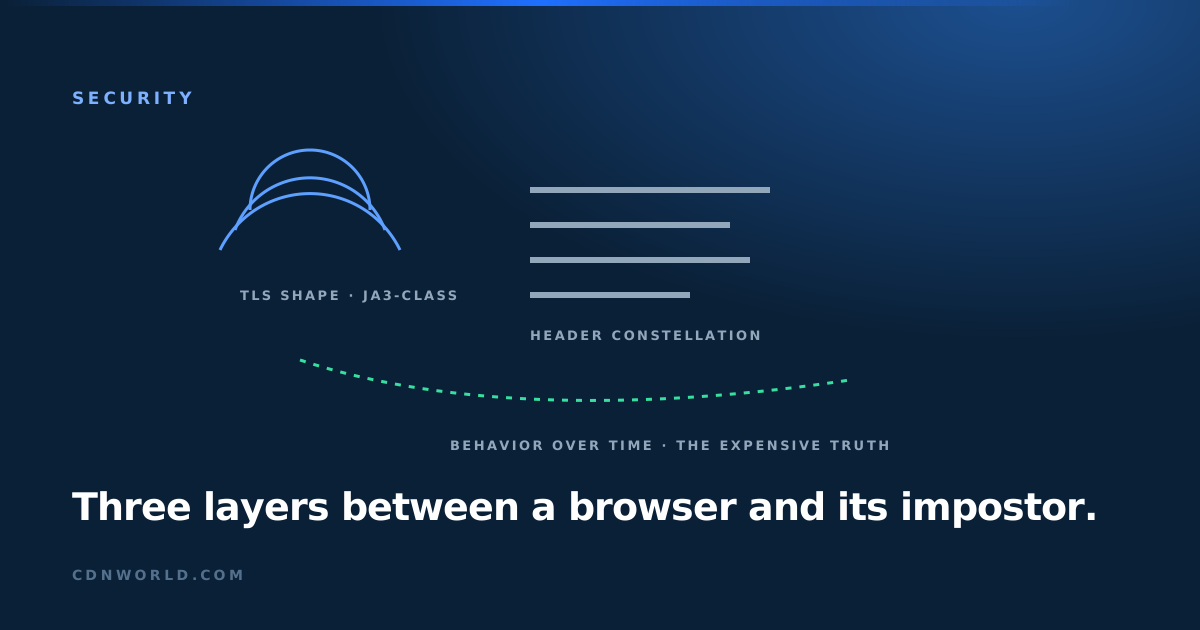
Every TLS client announces itself structurally: cipher suites, extensions, curves, in an order characteristic of its library. Hashing that structure (the JA3 lineage and successors) yields a fingerprint that distinguishes real Chrome from a Python script wearing Chrome’s User-Agent, because the header lies easily and the handshake does not, at least not cheaply. HTTP/2 adds more structure (settings, frame ordering), and the composite identifies client software with useful confidence. Countermeasure and counter-countermeasure: sophisticated bots now replay genuine browser fingerprints, which is why no serious system stops at this layer.
Header and protocol forensics
Real browsers emit consistent constellations: header ordering, accept values, compression support, cookie handling, redirect behavior, and cheap automation gets these subtly wrong in dozens of testable ways. Individually weak, collectively strong: consistency checking across the constellation (does this claimed Safari accept what Safari accepts, in Safari’s order?) catches the middle tier of automation that survives the TLS layer.
The economic frame from our bot-management comparison bears repeating with the mechanics now visible: each detection layer raises the attacker’s unit cost, scripts must become browser automations, automations must acquire residential paths and human-shaped behavior, and the defense succeeds not by perfection but by pricing most adversaries out of profitability for your specific assets. This also predicts where detection is heading as agentic automation proliferates: intent-based policy (which automated clients do we welcome, on which paths, at what rates) is displacing binary bot-or-not, and estates with clean partner-automation workflows today are pre-adapted for that world. Classification is becoming admission policy, not border defense.
Behavior, the expensive truth
The top tier runs real browsers, so structural signals converge on legitimate; classification falls to behavior: request pacing and paths, interaction telemetry where products collect it, session shapes across time, and reputation networks aggregating all of it across a vendor’s customer base. This is where machine learning earns its keynote slot, and where explainability matters operationally: when a partner integration gets classified as automation (it will), the vendor’s ability to tell you which signals fired decides whether the fix takes an hour or a week.
In practice
For buyers, the layer model turns into questions: which layers does the vendor run, what does the customer-visible verdict evidence look like, and what are the override ergonomics? For your own estate: keep an allowlist workflow for known partners (fingerprints and tokens, not IP folklore), monitor challenge and block rates by traffic segment, and treat sudden fingerprint-distribution shifts as security telemetry, they frequently announce new scraping campaigns before any rate limit notices.
Bot-defense reviews here include a fingerprint-layer walkthrough on your own traffic sample. Seeing your constellation is clarifying.