
Running two authoritative DNS providers is the single most effective resilience move most estates never make — if one provider has a bad day, the second keeps you resolvable. The historical objection was DNSSEC: signed zones seemed to force a single signer. The multi-signer model, standardised in RFC 8901, removed that objection. This guide is the two patterns that actually work, and the one decision that picks between them.
Why one DNS provider is a single point of failure
You can build multi-region compute, buy a second CDN, and laminate failover runbooks — and still sit entirely behind one authoritative DNS provider. A CDN failure degrades you; a DNS failure erases you. If resolution fails there is no address to connect to, no error page to serve, and usually no failover, because failover itself often rides on DNS. History keeps teaching this: every few years a major authoritative provider takes an outage and a swathe of the famous internet goes dark with it for hours.
The fix is not a better single provider. It is two independent providers, so that a failure at one is a degradation, not an extinction. The protocol was designed for exactly this — resolvers retry across the full set of name servers — and it has been there since the 1980s. What changed recently is that DNSSEC stopped being a reason not to do it.
The two-provider play in plain terms
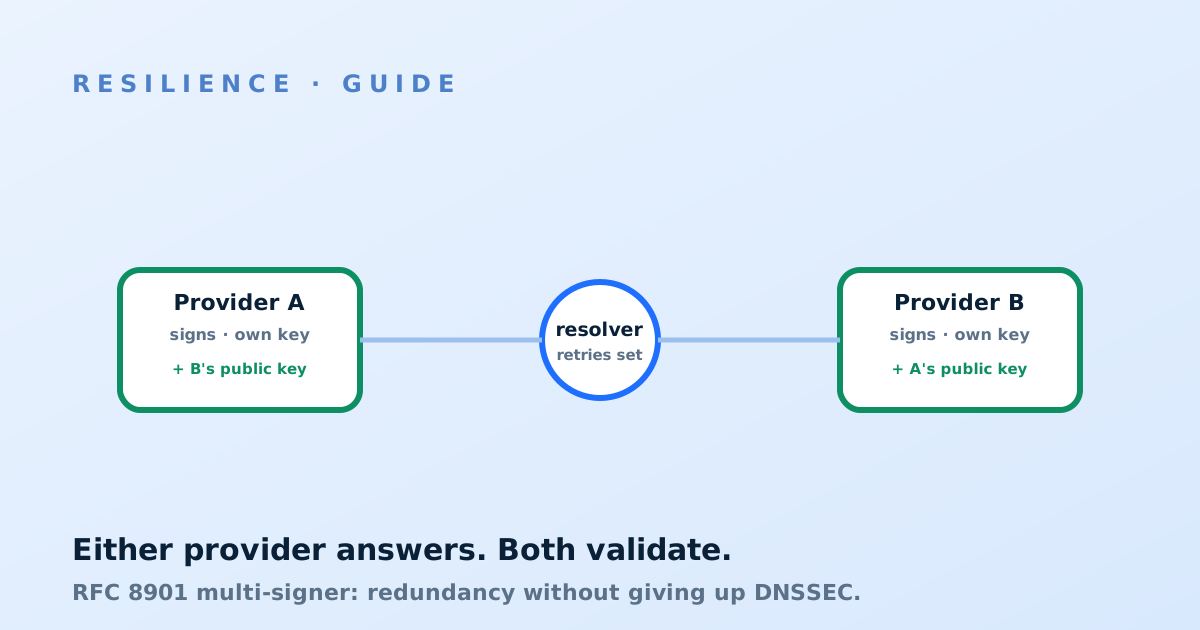
You publish name-server records from two independent providers — typically four to six name servers split across them. A resolver that fails to get an answer from provider A automatically retries provider B within its own retry timer. There is no failover logic to write; the redundancy is built into how resolution works. The only genuinely hard part is keeping the zone data — and its DNSSEC signatures — consistent across two systems that sign independently.
That is where the two patterns diverge. One provider can be the source of truth and the other a follower; or both can be primaries that each sign. The choice hinges on one question: do you need provider-specific features — traffic steering, geo-routing, weighted answers — alive on both sides, or is a faithful copy of a static zone enough?
Pattern one: primary–secondary with zone transfer
The simpler pattern makes one provider primary and the second a secondary that slaves the zone by standard zone transfer (AXFR/IXFR). You edit in one place; the transfer keeps the second in sync automatically. For DNSSEC, the primary signs and the secondary serves the already-signed records — the signatures travel with the zone, so both providers answer with valid, identical RRSIG data. It is robust and low-maintenance.
The limitation is that anything computed dynamically does not survive a zone transfer. If your primary generates geo-targeted or latency-based answers on the fly, the secondary only receives whatever static snapshot the transfer carried. For a zone that is essentially fixed records, this pattern is the right default: least moving parts, least to go wrong.
Pattern two: dual-primary multi-signer
When you need each provider's own steering features live, both providers act as primary and each signs the zone with its own keys. This is the multi-signer model from RFC 8901. The trick that makes it work: each provider imports the other's public zone-signing key into its DNSKEY set, so that whichever provider answers a query, the resolver can validate the signature against a key present in the published key set. You push record changes to both providers through automation — Terraform with two DNS providers is the usual implementation — rather than editing one and hoping.
Multi-signer comes in two variants: both providers can share a single signing key (simpler, but requires trusting both with the same private key), or each keeps its own key and publishes the other's public key (no shared private key, more moving parts). The own-key variant is the stronger security posture. Either way, “DNSSEC makes multi-provider impossible” stopped being true years ago — it is a real project, not a blocker.
TTLs, testing, and the failover clock
Set TTLs with a split personality. Infrastructure records — the NS set and anything you will not change in a hurry — can carry long TTLs measured in hours, for stability. The records you would change in an emergency, the A and CNAME at your traffic edge, need short TTLs, sixty to three hundred seconds, because that TTL is your failover clock. The archaeology problem is real: a record set to an 86,400-second TTL years ago is still cached out there, and it turns a five-minute failover into a day-long one.
And test it, because an untested redundancy is a belief, not a capability. In staging, pull one provider's name servers and confirm resolution survives on the other; validate that both providers return correct RRSIG data so validating resolvers do not reject the signed zone. If you have never tested the failover, you do not have it. This pairs naturally with treating a deliberate DNS TTL strategy and with benchmarking authoritative providers the same way you benchmark CDNs.