
HTTP/3 and QUIC support across the major CDNs in 2026 — defaults, toggles, the notable holdout, and when the protocol actually pays.
Winner depends on your workload.
Winner depends on: almost nothing — HTTP/3 is now a default or a free checkbox nearly everywhere, so the real comparison is edge-to-client only versus deeper QUIC integration, plus the one significant absence: Azure Front Door, which still does not serve HTTP/3 at all.
The protocol race is over; the checkbox audit is not
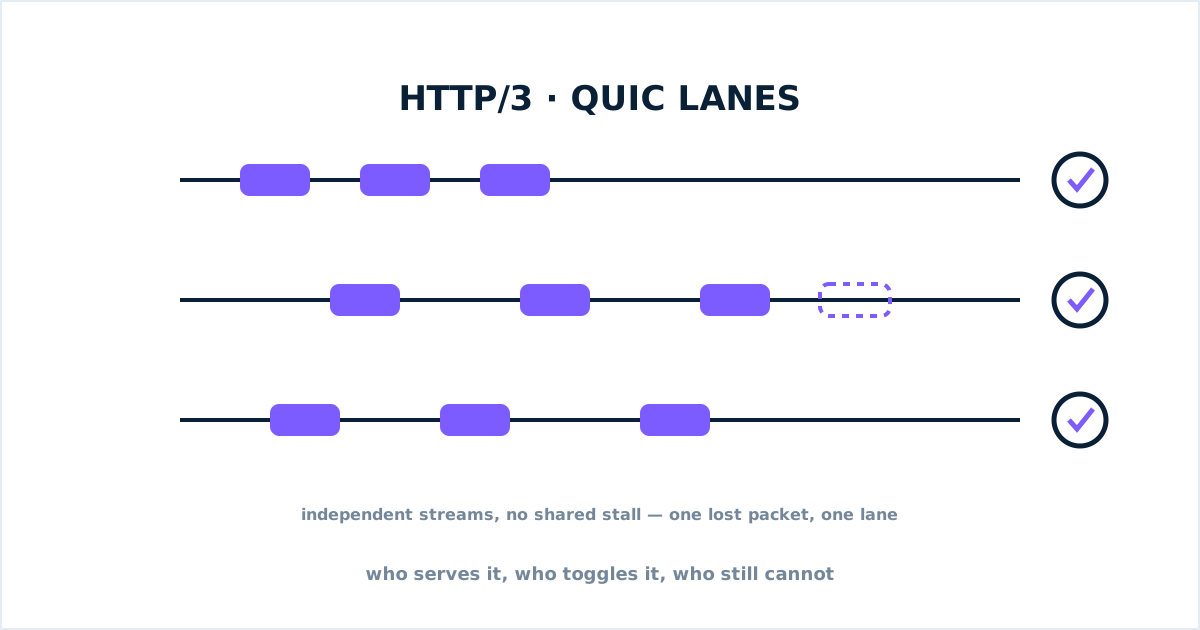
HTTP/3 moves HTTP onto QUIC over UDP: transport-level encryption, no TCP head-of-line blocking across streams, connection migration when a phone hops networks, and a faster handshake — especially on resumption. In 2026 the majors have almost all shipped it, so a comparison piece is less a horse race than an audit: is it on by default, is it a toggle, does it cost anything, and does anyone still lack it? One answer to the last question will surprise Azure-centric teams.
| Provider | HTTP/3 status | Notes |
|---|---|---|
| Cloudflare | Supported, one-click, effectively default | Early QUIC implementer; HTTP/3 prioritization work continues per its 2026 posts |
| Amazon CloudFront | Supported since 2022 as a per-distribution setting | No additional charge; clients fall back to H2/H1 automatically |
| Fastly | Supported — HTTP/3 & QUIC listed as a platform product | Enabled per service; Fastly contributed heavily to QUIC standardization |
| Akamai | Supported on modern delivery products | Enabled via the delivery configuration |
| Google Cloud CDN / Media CDN | Supported | QUIC originated at Google; H3 long enabled on its front ends |
| Bunny.net | Included on all plans | Listed among core features at no extra tier |
| Gcore / CDN77 | Supported on current platforms | Toggle per resource |
| Azure Front Door | Not supported as of mid-2026 | HTTP/1.1, HTTPS and HTTP/2 only, per Microsoft's own Q&A guidance; no public timeline |
The holdout
Azure Front Door is the notable absence. Microsoft's moderators confirmed as recently as early 2026 that AFD does not serve HTTP/3 and offers no timeline, leaving client connections on HTTP/2 at best — a strange gap for a first-party cloud edge given that IIS and Windows networking stacks support QUIC elsewhere in the estate. If your audience skews mobile — the population that benefits most from connection migration and loss-tolerant streams — this belongs on the debit side of any AFD evaluation, alongside the points we tallied in CloudFront vs Azure Front Door.
Edge-to-client is the honest scope
Every implementation above terminates HTTP/3 at the edge and speaks HTTP/2 or 1.1 to your origin. That is the right architecture — the lossy, high-RTT segment is the last mile, which is exactly where QUIC's recovery behavior earns its keep — but it means enabling H3 changes nothing about your origin pulls, your cache behavior, or your purge story. It also means the alt-svc dance governs adoption: the first visit arrives over TCP, discovers H3 via the Alt-Svc header, and upgrades on subsequent connections, so your H3 share will never be 100% and cold-visit metrics will not move as much as warm ones.
What it is actually worth
Measured impact concentrates in three places: handshake time on repeat visits (0-RTT and 1-RTT resumption versus TCP+TLS's multi-round-trip setup — the milliseconds we counted in TLS 1.3 and 0-RTT at the edge), tail latency on lossy links where one lost packet no longer stalls every stream, and session survival across network changes. On clean fiber to a desktop, the delta is small. On a phone leaving a car park, it is the difference between a stall and a seamless hop. Price the feature by your audience, not by the spec sheet — and since the feature is free everywhere it exists, the only real question is whether your CDN is on the list at all.
How to verify, not trust
Turn it on, then prove it: curl --http3 -sv against a cached asset, check for alt-svc: h3 in first responses, and watch the protocol split in your RUM data rather than the vendor dashboard — the operator-level view we built in QUIC internals for operators. Expect adoption to plateau near your repeat-visitor share. Facts verified against provider documentation, July 2026.
Want to know what share of your real users would ride HTTP/3 — and what it would do to your p95? The assessment answers with your data.