
The capstone of our hundred-comparison series: the whole delivery market on one map — tiers, adjacencies, regional layers and the forces redrawing them.
Winner depends on your workload.
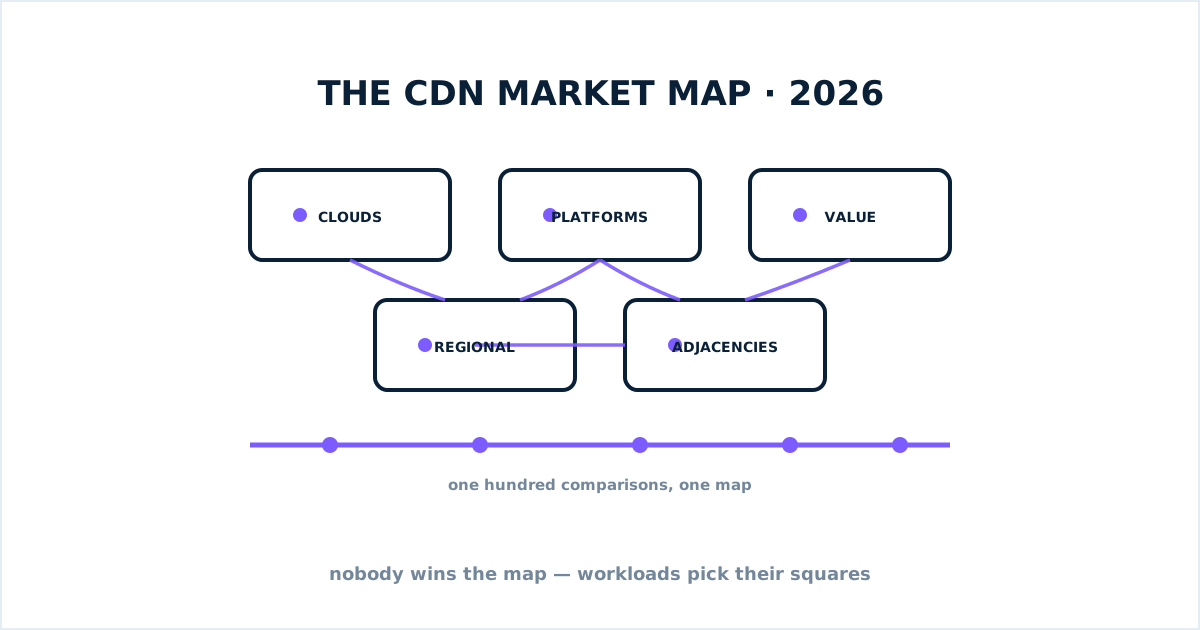
Winner depends on: your workload — which is the finding of the whole series. The market has settled into legible tiers: hyperscaler clouds selling gravity, platform independents selling delivery excellence, a value tier selling honest bytes, regional and sovereign specialists selling locality, and an adjacency belt (DNS steering, orchestration, monitoring, media platforms, zero-egress storage) where the interesting competition now lives. Nobody wins the map; workloads pick their squares.
The map, in five tiers
A hundred comparisons in, the market's shape is legible. Tier one, the hyperscaler clouds — CloudFront, Google Cloud CDN, Azure Front Door — sell delivery as gravity: strongest exactly where your estate already lives, priced to reward staying, structurally covered in clouds vs independents. Tier two, the platform independents — Akamai, Cloudflare, Fastly — sell delivery as a discipline: edge compute, security stacks and media machinery around the byte-moving core. Tier three, the value tier — Bunny, Gcore, CDN77, KeyCDN, and the sub-cent insurgents of the budget field — sells the byte itself, competently and transparently. Tier four, the regional and sovereign layer — from China's licensed world (mapped here) through the Gulf's carrier tier, India's domestic networks, LATAM's Azion and the APAC specialists — sells locality, licensing and last-mile truth. And tier five, the DIY substrate of Varnish and nginx, remains the quiet competitor that keeps everyone else's pricing honest.
The adjacency belt is where the game moved
The decade's real competition is happening around the CDN, not inside it. The steering layer — managed DNS with real decision machinery (compared here) and the orchestrators above it (mapped here) — is turning delivery into a swappable commodity beneath a stable control plane. Zero-egress object storage (the bucket question) collapsed origin economics and with them a chunk of the CDN's old margin story. Measurement became infrastructure: RUM now steers traffic, not just dashboards (the RUM roundup), with synthetic fleets (compared here) as the independent check. Media platforms — the image four-way (here) and the video field (here) — unbundled the highest-value workloads into their own markets. And the edge-compute platforms (the field) turned CDN choice into platform choice, the stickiest decision on the map.
Five forces redrawing the map
Watching the series' hundred data points move over the year, five vectors stand out. Consolidation at the middle: the mid-tier keeps getting acquired or squeezed between platform breadth above and price floor below — the StackPath-and-Edgio pattern that opened this series has not finished running. Sovereignty everywhere: China's licensing model turned out to be the preview, not the exception; the Gulf, India and Europe are all pulling delivery decisions toward compliance-first shortlists. Standards eating steering: HLS content steering and Speculation Rules moved intelligence into formats and browsers, shrinking what only proprietary platforms could do. The commodity floor keeps falling — a quarter-cent per gigabyte, and negotiating leverage falling with it into every renewal on the map. And measurement-driven buying: the honest conclusion of a hundred verdicts is that per-ASN, per-workload measurement now beats every brochure claim in every tier — the market's marketing has simply stopped being the signal.
How to use this map
Every verdict in this series ends the same way on purpose: winner depends on your workload. So place yourself: origin location and gravity (tier one question), platform depth needed (tier two), price sensitivity and traffic shape (tier three), regulatory and regional surface (tier four), engineering appetite (tier five) — then let the adjacency belt supply steering, measurement and media specialization as the estate grows. The hundred pieces behind this one exist to make each of those squares concrete; the free assessment exists to run your numbers across them. Delivery stopped being a product you pick once — it became an estate you design. This map is where the design starts. Facts verified against provider documentation, July 2026.
One hundred comparisons, one question left: where does your workload sit on the map? The free assessment answers it with your data.