
A comparison rewritten by events: with Akamai’s direct mainland CDN wound down as of June 2026, “Akamai China” now means partner delivery — here’s what that changes.
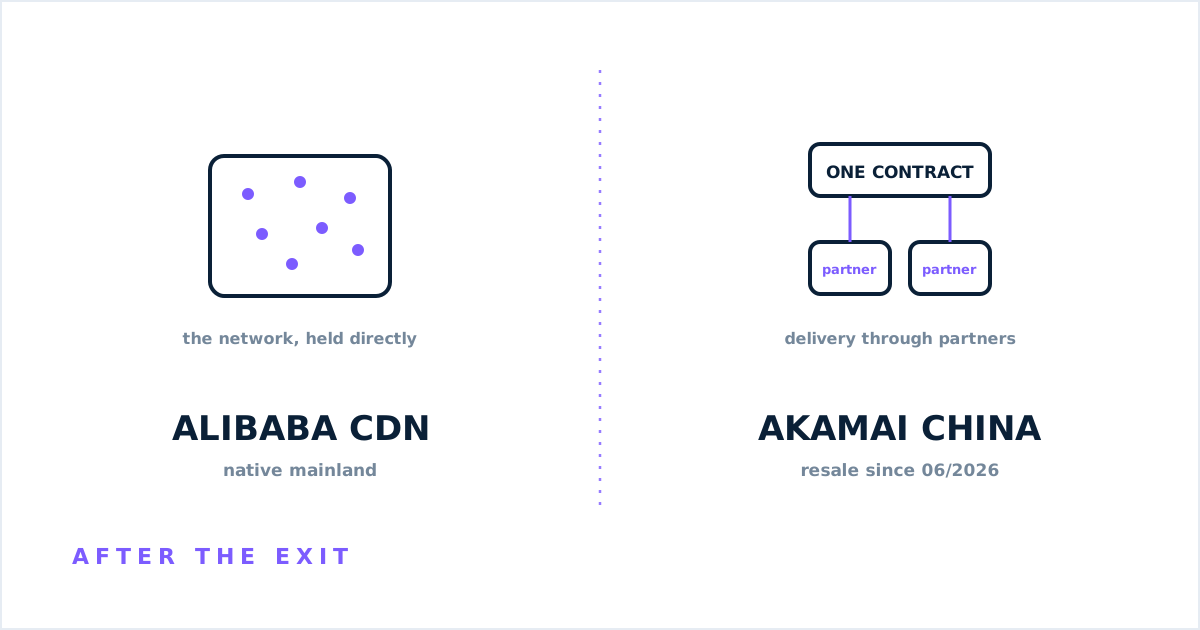
Winner depends on your workload.
Winner depends on: whether you want one global contract with mainland delivery handled through Akamai’s partners, or a direct relationship with China’s largest native network — and how your compliance team weighs an extra intermediary.
Side by side
| Alibaba Cloud CDN | Akamai (mainland China) | |
|---|---|---|
| Mainland infrastructure | Own network: 2,300+ PoPs across all 31 provincial regions | No own nodes: delivery via partners (historically Wangsu; transition to Tencent Cloud and Wangsu) |
| Status July 2026 | Business as usual | Direct China CDN operations ceased 30 June 2026; partner resale model |
| Mainland pricing | Published: from ~$0.04/GB, tiering down; traffic or peak-bandwidth billing | Contract-based, wrapped in the global Akamai agreement |
| Global network | 900+ overseas PoPs in 70+ countries | Thousands of PoPs; the deepest global footprint in the industry |
| Compliance | ICP filing; direct Chinese-entity relationship | ICP filing; delivery through licensed local partners |
| Best for | China-centric estates wanting native control | Multinationals wanting one vendor across the firewall |
The comparison events rewrote
For two decades this matchup was “China’s biggest native CDN versus the global leader’s in-country partnership.” As of 30 June 2026 it needs rewriting: Akamai has ceased direct CDN operations in mainland China, ending its long-running delivery arrangement built on partner infrastructure — principally Wangsu (ChinaNetCenter) — and transitioning mainland customers to partner-provided service resold through Akamai, with Tencent Cloud and Wangsu named as the landing networks. “Akamai China” still exists as a commercial offer; what changed is that it is now explicitly a resale of local networks rather than an Akamai-operated service.
What Alibaba brings that didn’t change
Alibaba Cloud CDN remains what it was: the largest native mainland network, with over 2,300 PoPs covering all 31 provincial-level regions, 900-plus PoPs overseas, and published metered pricing — mainland delivery from roughly $0.04/GB at the entry tier, stepping down with volume, billable by traffic or daily peak bandwidth. Its edge products have consolidated (the DCDN lineage now sells as Edge Security Acceleration), origin integration with OSS and ECS is native, and the commercial relationship is direct: your China entity contracts with the network that owns the nodes. For estates whose center of gravity is China, that directness is the product. Figures checked against Alibaba’s published pricing, July 2026.
What the Akamai model now means
The post-June model has real logic for a specific buyer: the multinational that wants one vendor, one integration and one support chain on both sides of the firewall. Akamai’s global network remains the industry’s deepest, and wrapping partner-delivered mainland service into that global contract preserves single-vendor procurement — the same property config concepts, one bill, one escalation path. The trade-offs are equally real: an extra commercial layer between you and the machines serving your traffic; mainland performance now determined by the partner’s network (excellent networks, but not Akamai’s); and migration work for incumbents — any architecture document that assumed Akamai-operated mainland nodes describes infrastructure that no longer exists, a pattern we’ve seen before in vendor wind-downs like the Edgio post-mortem.
The compliance layer nobody skips
Neither path avoids China’s rules. Serving cached content from mainland nodes requires an ICP filing tied to a China-registered entity on either provider, and data-residency obligations apply regardless of whose logo is on the invoice. The practical difference is relationship shape: with Alibaba you hold the license relationship against the network operator directly; with Akamai’s model, licensed local partners operate the infrastructure while your global contract sits above it. Legal teams differ on which they prefer — ask yours before procurement does.
How to decide
Decide by center of gravity. China-first businesses — mainland revenue, mainland ops team, Alibaba or Tencent cloud estate — should hold the direct native relationship; Alibaba’s network and published meters make it the default, benchmarked against Tencent per our 2026 POP maps rematch. Global-first businesses with a meaningful-but-minority China audience can reasonably keep the single-vendor Akamai wrapper — while insisting on transparency about which partner network carries their traffic and re-benchmarking after the transition. And every incumbent Akamai China customer should treat this year’s renewal as a genuine re-tender, not a rollover: the service behind the contract changed.
Caught in the Akamai China transition? The assessment re-benchmarks your mainland delivery across native and partner options before you re-sign.